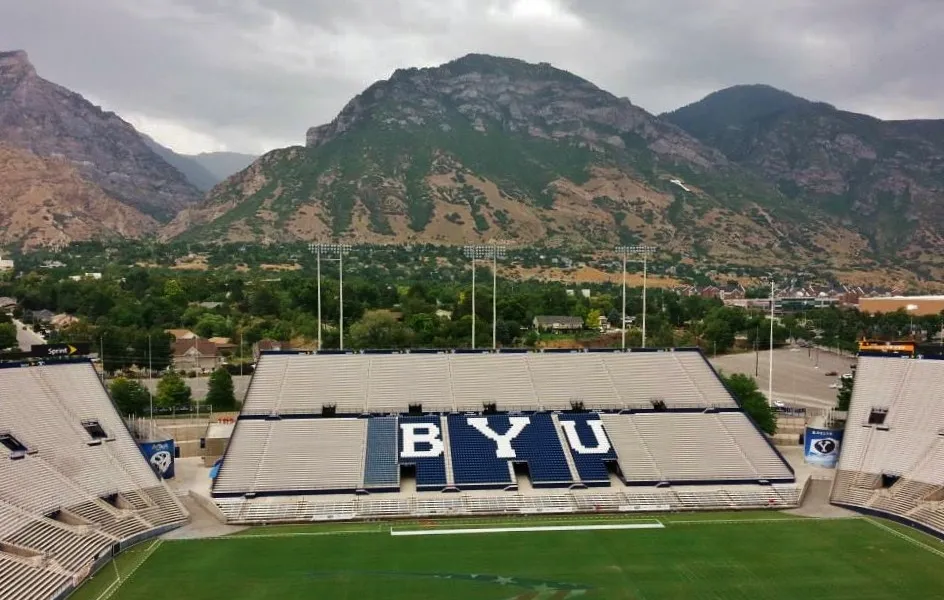
BYU football is coming off a 12-2 season — one of the best in program history — and the bar for 2026 is high. The useful question is not whether fans should be excited. They should. The useful question is what has to carry over when last season’s proof turns into this season’s expectation.
The Cougars no longer get to sneak up on the Big 12. A 12-win season changes how opponents prepare, how poll voters frame every close game, and how thin the margin feels when September arrives. Here is the launch-page version of the 2026 watch list: schedule shape, returning production, defensive reliability, and the player pages that will tell us whether the roster is still climbing.
The schedule gives BYU a runway — then asks for proof
The 2026 slate opens with Utah Tech before the schedule moves into a much more revealing stretch: Arizona, Colorado State, TCU, Iowa State, Notre Dame, UCF, Arizona State, Utah, Baylor, Kansas, and Cincinnati. The first job is simple enough to say and hard enough to live: avoid early slippage, protect the quarterback, and reach conference play with the rotation settled.
That matters because the middle of the schedule is where a good roster becomes a contender or a weekly coin flip. BYU gets a mix of Big 12 physicality, rivalry pressure, and national-brand attention. Fans should keep one eye on the official kickoff/broadcast updates, but the more durable story is roster management: how quickly the offensive line gels, how many defensive backs can be trusted, and whether the special teams avoid giving away hidden yards.
The how-to-watch pages are already built so each week can turn into a fresh utility page once TV windows are announced. That is good for fans and good for search: no guessing, no fake channels, just the facts as they become official.
Returning production is the floor, not the ceiling
The Cougars return real production. The current football roster is deep enough that the player pages can do more than list names; they can show which claims are backed by career numbers. That matters after a 12-2 year because “experienced” can mean two different things: players who were on the sideline for a great season, and players who actually carried snaps when games got tight.
A few areas to watch:
- Running back depth anchors the offense. LJ Martin gives the leaderboard a proven centerpiece, and the surrounding depth should decide how fresh the run game looks in November.
- Quarterback efficiency will shape the ceiling. Bear Bachmeier already has career production in the data set; the next step is consistency against Big 12 speed.
- Linebacker and safety tackling remain the defense’s stabilizers. When BYU wins cleanly, it usually avoids cheap explosive plays and forces opponents to earn long drives.
- Receiver development is the swing piece. The Cougars need enough perimeter answers that defenses cannot overload the box and dare BYU to win one matchup.
We track career stats and game logs on every player page — the best way to settle a “who’s actually been better” argument without leaning on vibes.
The 2025 result set is both evidence and warning
The results page shows the headline number: 12-2. It also shows why 2026 should be covered with some discipline. A great record does not mean every weakness disappeared; it means the team solved enough weekly problems to stack wins. That distinction matters for preview coverage.
If BYU’s defense keeps tackling at last year’s level and the offense avoids negative-play avalanches, the Cougars can stay in the Big 12 race deep into the season. If early-down efficiency slips or the rotation gets too top-heavy, the same schedule can become a grind. The job for this site is to track those signals week by week: not just final scores, but who played, who produced, and which trends are sustainable.
What fans should watch first
Before fall camp narratives get loud, start with three practical checkpoints:
- Health and snap distribution. The roster can look deep in June and feel thin by October. Rotation notes matter.
- Explosive-play balance. BYU needs both chunk plays and chunk-play prevention. One without the other creates weekly stress.
- Broadcast clarity. TV windows drive the search spike. When networks are set, each matchup page should be refreshed with kickoff, channel, streaming, venue, and last-meeting context.
The bottom line
After 12-2, the expectation has shifted from “nice story” to “contender.” The schedule gives BYU a path, but it also removes the comfort of anonymity. We will be covering every snap — and the recruiting, portal, roster, and utility updates between now and kickoff.
Source links
- BYU Sport Nuts: 2026 BYU football schedule, football roster, and 2025 results
- BYU Athletics: official BYU football schedule and official BYU football roster
Want the season delivered? Join The Cougar Report.