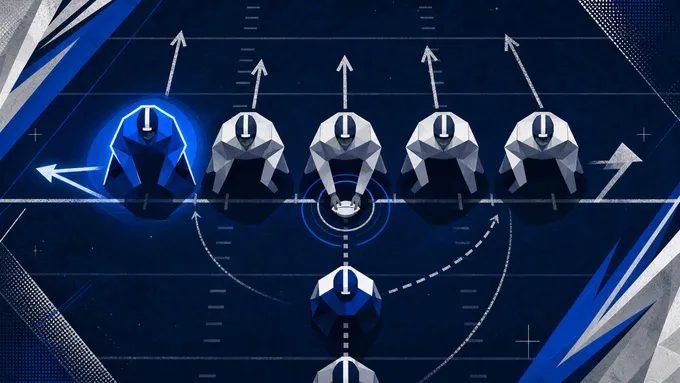
The offseason is where offensive linemen become folk tales.
A player gets a number, a frame, a practice whisper and suddenly he is either the next anchor or the next panic button. That is why the latest Google News discovery item around Andrew Williams is useful only if BYU fans resist turning it into a one-man verdict.
Williams is interesting. The official BYU roster lists him as a 6-foot-8, 295-pound redshirt freshman offensive lineman from Kirksville, Missouri, and the local BYU Sport Nuts stat database credits him with two games played. A young tackle-sized body with game exposure is exactly the kind of profile that makes June optimism feel legal.
But the bigger story is not just whether Williams breaks out. It is whether BYU has built an offensive line room where a player like Williams can grow into a role without being asked to rescue the entire offense by Tuesday.
That difference matters in the Big 12. It also explains why BYU’s 2026 line depth may be one of the quietest swing factors on the roster.
The Williams case starts with traits, not certainty
There is a reason linemen like Williams attract attention before they have a thick public stat line. The frame is obvious. At 6-foot-8, he gives BYU the kind of length that can matter on the edge, especially in pass protection where one half-step can decide whether the quarterback is comfortable or doing emergency youth-camp footwork.
The class year matters, too. Williams is listed as a redshirt freshman, not a finished product. That should make fans more patient, not less. Offensive line development is not a vending machine. It is footwork, strength, communication, leverage, snap timing, recovery technique and the unglamorous art of being wrong less loudly each week.
The two-game number in the WMT-derived stat feed is modest, but it is not nothing. For a young lineman, any live-game exposure is a data point: meetings become less theoretical, travel routines become normal, and film correction starts coming from actual Saturdays instead of practice hypotheticals.
That is the proper lens. Williams is not a guaranteed answer because a June headline says he could be one. He is a plausible developmental answer because the measurable profile and early exposure give BYU something to work with.
BYU’s line is deep enough to make development possible
The facts-only BYU football roster currently lists 20 offensive linemen. That room is not just large; it is layered.
The class mix is notable:
| Offensive line class group | Count on current roster | Why it matters |
|---|---|---|
| RS-Senior | 5 | Enough older bodies to keep the room from becoming a freshman lab experiment. |
| RS-Junior | 2 | Bridge players who should understand both development and weekly preparation. |
| RS-Sophomore | 3 | The age band where linemen often start turning practice traits into reliable snaps. |
| RS-Freshman | 7 | The upside shelf, including Williams, that determines the room’s next wave. |
| True freshman/sophomore | 3 | Longer-term pipeline pieces, not players who should all be forced into emergency duty. |
That distribution is the real BYU story. A 20-man line room with five redshirt seniors can absorb young-player development better than a room where every promising freshman has to play because nobody else is available.
It also creates competition without demanding chaos. Williams does not have to be crowned in June to matter in September. He can push veterans. He can become a second-unit answer. He can earn a package role. He can make the staff more comfortable if injuries arrive, because injuries always RSVP to offensive line meetings whether invited or not.
That is how good programs turn depth into leverage. The best-case scenario is not a fan board declaring one winner. It is BYU entering game weeks with multiple playable combinations and fewer positions where one rolled ankle turns the plan into interpretive dance.
The size profile says BYU is not small up front
The current offensive line group averages roughly 6-foot-5 and 305 pounds using the listed roster heights and weights. Williams fits that profile from the long end: taller than the room average, slightly lighter than the average, and young enough that strength development can still change the conversation.
That last point is important. A 295-pound redshirt freshman does not need to be treated the same as a 315-pound senior. The question is not whether Williams already looks like the final version of an upperclassman Big 12 tackle. The question is whether BYU can develop him in a way that turns length into functional power without sacrificing movement.
For BYU, that balance is more than a scouting note. The 2026 schedule includes games where the offensive line will need different answers. Arizona, TCU, Notre Dame, Utah, Baylor, Kansas and Cincinnati do not all stress an offense the same way. Some weeks are about speed on the edge. Some are about interior displacement. Some are about surviving pressure looks long enough for the quarterback menu to stay open.
A deep line room lets BYU adjust. A thin one forces the Cougars to pretend every problem is the same problem wearing a different helmet.
Why this matters for Bear Bachmeier and LJ Martin
Offensive line analysis can feel like a separate church meeting from quarterback and running-back talk, but it is the room that decides whether the fun parts of the offense are actually fun.
For Bear Bachmeier, protection is not just about avoiding sacks. It is about keeping the offense out of predictable long-yardage situations and letting his legs remain a weapon rather than a fire escape. A young quarterback with a live run threat becomes much more dangerous when the line gives him normal downs and distances.
For LJ Martin, the line decides whether his workload is efficient or merely heroic. Martin’s production is already real — 2,541 rushing yards and 23 rushing touchdowns in the local database — but BYU’s best version of Martin is not 25 exhausted collisions into stacked boxes. It is a back getting meaningful lanes, useful screen opportunities and red-zone touches that punish defenses for worrying about everything else.
That is why Williams’ development is not an isolated subplot. If BYU can build a second wave of linemen behind veterans like Bruce Mitchell, Andrew Gentry, Sonny Makasini and Trevin Ostler, the offense becomes less fragile. The Cougars do not need every young lineman to become an instant starter. They need enough of them to become trustworthy enough that the weekly plan survives contact.
The 5-for-5 roster era raises the bar
The current college-football roster conversation is shaped by scholarship and eligibility changes that make depth management feel more like cap table work than old-fashioned roster hoarding. The news-radar cluster around BYU and the broader NCAA roster environment is a reminder: programs cannot simply keep every useful developmental body forever and assume the math works out.
That makes evaluation sharper. A 20-man offensive line room is valuable, but only if the staff knows who is a current-game answer, who is a year-away answer and who is being carried by reputation instead of trajectory.
Williams sits in the productive tension of that new world. His frame and class make him a player worth developing. His limited game log means the public case is still early. BYU has enough older linemen that he should not be forced before he is ready, but enough future uncertainty that his jump would materially change the room.
In other words: the Williams question is not hype versus doubt. It is timing.
What fans should watch in camp and September
The useful questions are less dramatic than “Is he a star?” but they will tell us more.
- Where does Williams get reps? Tackle-only development is different from cross-training. Position flexibility can speed a path to the two-deep, but too much shuffling can slow mastery.
- Does his listed weight move? If he adds functional strength while keeping movement, the 6-foot-8 frame becomes more playable.
- Who runs with the second unit? BYU’s season may hinge on backup line readiness as much as the first five.
- Can the young linemen avoid penalty drives? False starts and holds are often the tax paid by inexperienced blockers.
- Does BYU rotate early? Meaningful first-half snaps against early opponents would say more than late garbage-time appearances.
If those signs are positive, Williams does not need a headline role to be a meaningful 2026 development. He just needs to make the offensive line room more trustworthy than it was without him.
The takeaway
Andrew Williams is a good offseason name because he represents the kind of bet BYU has to win: long, young, developmental and positioned in a room where patience is possible but progress is necessary.
The Cougars’ offensive line has enough bodies, enough size and enough older players to avoid desperation. Now the challenge is turning that inventory into usable depth. Williams can be part of that answer, especially if his next step gives BYU another tackle-sized option behind the veterans.
So yes, pay attention to No. 68. Just do not make him carry the whole line in your imagination.
BYU’s 2026 offense will not be defined by one June breakout candidate. It will be defined by whether the Cougars can turn a 20-man offensive line room into a stable weekly advantage for Bachmeier, Martin and the rest of an offense trying to stay relevant deep into Big 12 play.
That is a bigger story than a single depth-chart prediction. It is also the kind of story that tends to decide November while everyone else is still arguing about skill-position stars.
Source links
- Google News discovery: 68 days until BYU football: Offensive lineman Andrew Williams is poised for a breakout second season
- Official BYU Athletics: Andrew Williams roster page
- Official BYU Athletics: BYU football roster
- Official BYU Athletics: BYU football schedule
- WMT/BYU stat source used by BYU Sport Nuts: Andrew Williams stats widget
- BYU Sport Nuts context: Andrew Williams player page, football roster, football schedule, LJ Martin workload analysis
Want the roster math before the hot takes start lifting weights? Join The Cougar Report.