The most dangerous offseason compliment is the one that turns a real player into a magic wand.
That is the risk with LJ Martin. The latest Google News discovery item from Roundtable put Martin in the conversation around college football’s top running backs, and BYU fans do not need much convincing there. Martin’s BYU Sport Nuts player database line is already star-shaped: 33 games, 26 starts, 482 rushing attempts, 2,541 rushing yards, 23 rushing touchdowns, 57 receptions, 398 receiving yards, and 26 total touchdowns.
That is not hype. That is evidence.
But if BYU wants Martin to be a Big 12 difference-maker in 2026, the important question is not simply whether he is good enough. He is. The better question is whether the Cougars can make his workload sharp instead of merely heavy.
The star case is easy
Martin’s profile checks the boxes that make running backs travel in conference play.
He has volume. A back does not reach 482 career carries by being a September ornament. He has efficiency, with 5.27 yards per rush in the local WMT-derived stat feed. He has touchdown value, with 23 rushing scores and three receiving touchdowns. He has receiving utility, which matters because Big 12 defenses are happy to punish predictable personnel tells.
He also has the kind of build and experience that turns ordinary second-and-6s into offense-saving plays. The official BYU roster lists Martin at 6-foot-2 and 205 pounds, a senior from El Paso, Texas. That does not mean he should be treated like a vending machine for inside zone. It means BYU has a proven runner whose best snaps can change the geometry of a game.
The Cougars should absolutely build around that. They just cannot build only around that.
The workload trap
Running-back praise can get lazy fast. A player is great, so the answer becomes: give him the ball more. That sounds sturdy until November arrives wearing steel-toed boots.
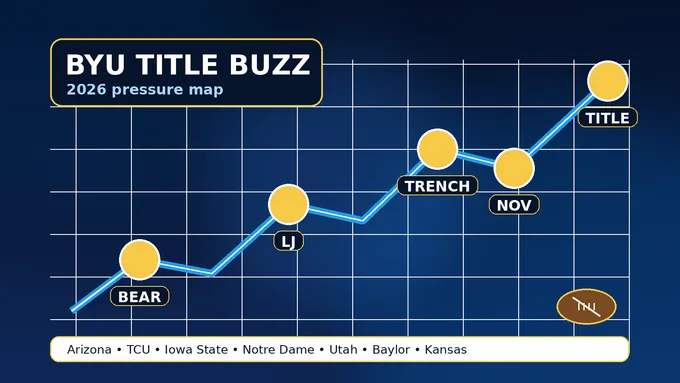
BYU’s 2026 schedule is not built for empty calories. The football schedule includes Arizona, TCU, Notre Dame, Utah, Baylor, Kansas and Cincinnati. If BYU is still playing games that matter late, Martin’s most valuable touches cannot be spent proving a point in low-leverage spots. They have to tilt possessions.
There is a difference between touch count and touch quality:
| Touch type | Why it matters for BYU |
|---|---|
| First-down early runs | Keep BYU ahead of schedule and protect the quarterback menu. |
| Red-zone carries | Turn Martin’s finishing skill into points, not just yardage. |
| Four-minute offense | Let BYU close games without asking the defense to survive one more drive. |
| Screen/checkdown touches | Punish pressure without forcing Martin into constant box collisions. |
| Short-yardage tells | Useful when varied; dangerous if every linebacker in the stadium knows the script. |
The goal is not to bubble-wrap BYU’s best back. Football is not a museum. The goal is to keep Martin from carrying low-value stress while preserving the carries that make defensive coordinators start bargaining with their headset.
BYU has enough backs to make this a real choice
The facts-only BYU football roster currently lists nine running backs and 20 offensive linemen. That matters because workload management is not just an analytics slogan; it is a roster test.
If Martin is the only trusted answer, BYU’s offense becomes easier to time. If the staff can get useful snaps from the rest of the room, Martin becomes harder to defend because his touches can be chosen rather than forced.
That is where complementary names matter. Bear Bachmeier changes box math if the quarterback run game remains live. Bruce Mitchell gives the offensive line an experienced reference point with 38 games played and 20 starts in the local database. The receiver and tight-end rooms matter, too, because safeties only cheat downhill when the passing game lets them sleep without consequences.
Martin can be the engine. BYU still needs the rest of the offense to be more than passengers asking if Provo is there yet.
The best version of Martin helps the defense
A great BYU running back is not only an offensive weapon. He is a defensive assistant with cleats.
Against road speed games like Kansas, a patient rushing attack limits the number of possessions where BYU’s defense has to tackle grass in space. Against heavier Big 12 fronts, successful early-down runs keep the Cougars out of desperate protection calls. Against rivals — yes, especially the one up north — a physical back helps BYU avoid turning the game into a pure emotional bonfire.
That is why Martin’s value is larger than his stat page. A reliable runner changes how BYU can win. He allows the Cougars to shorten games when needed, protect leads without apologizing for it, and make play-action feel like a threat rather than a decorative sticker on the call sheet.
But that only works if Martin is fresh enough to make defenses fear the next carry. The 2026 target should not be a ceremonial chase for a round number. It should be a season where his touches arrive in the moments with the highest leverage.
What fans should watch early
By September, the box score will tempt everyone into the easiest argument: did Martin get enough carries?
Ask sharper questions instead:
- How many touches come on schedule? A five-yard run on first down is worth more than a seven-yard rescue on third-and-12.
- Is BYU using him in the pass game? His 57 career receptions are a feature, not trivia.
- Do backup backs get meaningful series? Not garbage-time cameos; actual snaps when the playbook still matters.
- Does the quarterback run threat hold backside defenders? Bachmeier’s legs can turn Martin’s lanes from crowded to honest.
- Are red-zone touches diverse? Martin should finish drives, but BYU cannot make him the only red-zone sentence.
If those answers are healthy, Martin’s season can be both productive and sustainable. If not, BYU risks turning one of its best advantages into a weekly load-bearing wall.
The takeaway
LJ Martin deserves the top-running-back conversation because the production is already on paper. BYU has a senior back with Big 12-tested volume, touchdown punch, receiving value and enough efficiency to make every defensive front account for him.
The 2026 challenge is stewardship, not belief.
BYU needs Martin central enough to define the offense and protected enough to matter when the season gets mean. That means using the roster around him, making the quarterback run game count, and treating touches as investments rather than fan-service receipts.
The best version of BYU’s offense is not “give LJ Martin the ball and hope.” It is “make every defense spend the whole afternoon worrying about when LJ Martin gets the ball next.”
That difference could decide whether BYU is merely physical in 2026 or physical enough to stay in the Big 12 race when November stops being polite.
Source links
- Roundtable/Google News discovery: Where BYU’s LJ Martin ranks among college football’s top running backs
- Official BYU Athletics: LJ Martin roster page
- Official BYU Athletics: BYU football schedule
- WMT/BYU stat source used by BYU Sport Nuts: LJ Martin stats widget
- BYU Sport Nuts context: LJ Martin player page, football roster, football schedule, BYU at Kansas edge-discipline preview
Want the roster math before the hot takes find a microphone? Join The Cougar Report.