BYU basketball has the sentence every modern recruiter wants.
Come here, play for Kevin Young, live in an NBA-style system, and the league will still find you.
That sentence is cleaner than it used to be. The national attention around AJ Dybantsa changed the way people talk about BYU hoops. Recent chatter around Young offering the No. 1 player in the 2028 class is part of the same story: BYU is no longer asking elite prospects to imagine a bigger version of the program. It is trying to behave like one.
Here is the catch, because there is always a catch in July: the pitch only works if the roster underneath it makes sense.
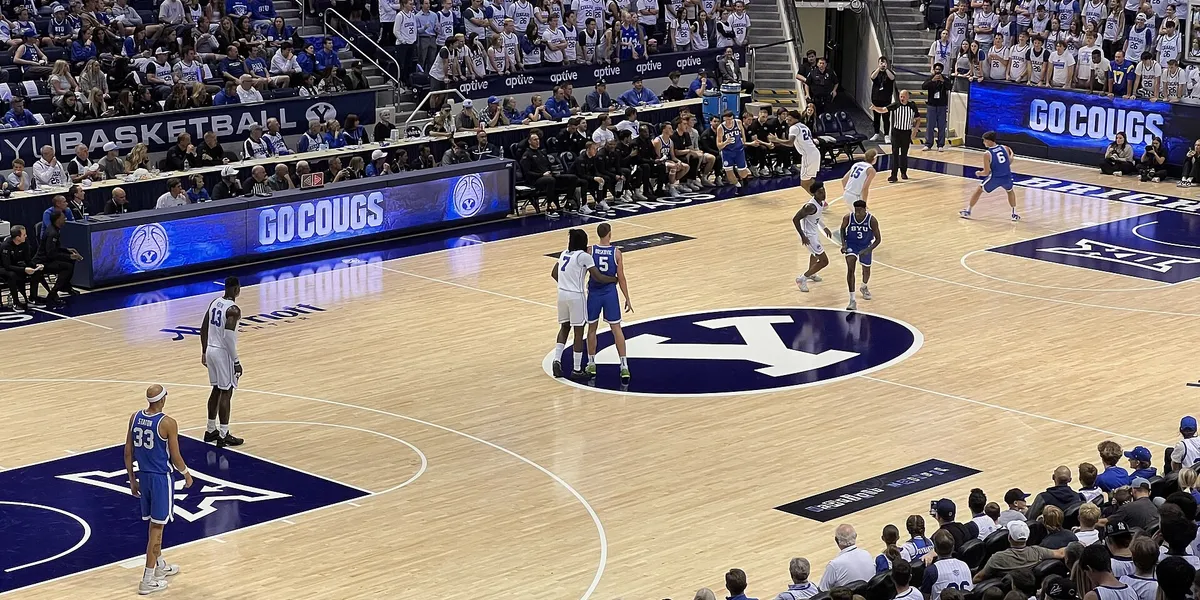
Right now, the official BYU men’s basketball roster lists 17 players. That is not a cute little rotation waiting to be announced. It is a crowded room with seniors, transfers, freshmen, international pieces, a lottery-level freshman spotlight, and enough frontcourt size to make a Big 12 scout start counting matchups before breakfast.
That is exciting. It is also where slogans go to die.
The roster tells on the pitch
The local BYU Sport Nuts roster database, pulled from BYU’s official roster feed, has the Cougars at 8 guards, 6 forwards, and 3 centers. The class split is just as interesting: six seniors, four sophomores, three freshmen, two redshirt freshmen, and two juniors.
That blend gives Young a real selling point. BYU can tell a five-star wing he will not be dropped into a rebuild with a ball and a prayer. Richie Saunders is a senior guard who knows the program. Robert Wright III brings Baylor experience. Keba Keita is a senior Big 12 body. Xavion Staton is a 7-footer with obvious long-term intrigue.
But the same facts create pressure. If you recruit like a pro program, players expect pro-level clarity. Who initiates offense? Who closes games? Which bigs are screen-and-dive players, which bigs can pass, and which players are developmental investments who should not panic if November minutes are weird?
Those answers matter more than the highlight clips.
BYU has seven players listed at 6-foot-8 or taller: Brody Kozlowski, Mihailo Bošković, Khadim Mboup, Keita, Dybantsa, Staton, and Abdullah Ahmed. Three are listed at 6-foot-10 or taller. The average listed height on the roster is roughly 6-foot-6.
That is not window dressing in this league. The Big 12 tends to turn soft roster ideas into dented sheet metal. Size helps, sure. But size without role clarity just gives you taller confusion.
The NBA pitch cannot be a one-player postcard
The easy version of the BYU story is all Dybantsa, all the time. That is understandable. Elite prospects bend coverage. They bend broadcasts. They make opposing fans suddenly very interested in NIL, admissions, taxes, church culture, shoe companies, and whatever else they can argue about online.
But BYU’s next recruiting step cannot be, “Look, we had AJ.”
That is a start, not a system.
The better pitch is more practical: BYU can pair elite talent with older guards, real size, national attention, Big 12 competition, and a coaching staff fluent in NBA language. That is the kind of pitch that might survive after one star leaves.
It also has to be honest. BYU is not for every prospect. Provo has its own rhythm. The Honor Code context is real. The Sabbath policy and faith-adjacent culture are part of the school, not background wallpaper. Some players will hear that and keep moving. Fine. The ones who stay interested need to see basketball benefits that are just as specific as the cultural fit.
That means development plans, not vibes.
For Dybantsa, the plan is obvious from the outside: put the ball in his hands, give him space, use his gravity, and let the NBA watch. For everybody else, the plan is harder and probably more important. Saunders still needs a role that lets him lead without becoming invisible. Wright needs trust at point guard. Keita and Staton need frontcourt definitions that do not step on each other. Dawson Baker, Nate Pickens, Kennard Davis Jr., Jared McGregor and KJ Perry give BYU guard options, but options only help if the staff makes choices.
That is the boring work fans rarely see until it breaks.
The international piece is not a side note
One thing that jumps off the roster is how global the room has become.
BYU lists players from Serbia, Senegal, Mali, France, Austria, and Egypt. Bošković, Mboup, Keita, Dominique Diomande, Aleksej Kostić, and Ahmed are not all the same kind of player, but they point to the same program question: can BYU make international and academy-path players feel coached, comfortable, and useful quickly?
That is where the recent Will Voigt staff-change conversation still matters. Voigt leaving for Boise State does not wreck the roster. It does, however, put a little extra spotlight on staff function. International transition, frontcourt development, scouting, and NBA-style teaching are not decorative staff duties on this roster. They are load-bearing.
If BYU hires or redistributes those jobs cleanly, fans may never notice. That would be the point.
What would make the pitch repeatable
BYU does not need another once-in-a-generation headline to prove the model works. It needs repeatable evidence.
A few things would count.
First, the Cougars need Dybantsa to look like a star inside a real team, not a guest celebrity dropped into a local run. If BYU wins and he still gets showcased, that is the dream recruiting clip.
Second, the non-Dybantsa players have to improve in visible ways. Maybe that is Saunders becoming a steadier late-clock answer. Maybe it is Wright controlling tempo. Maybe Staton becomes playable earlier than expected. Maybe Keita gives BYU grown-man minutes in January when the Big 12 stops being polite.
Third, the staff has to keep the locker room from becoming a math problem. Seventeen players means somebody good will sit. Somebody young will wait. Somebody experienced will have to accept less than he wants. That is not scandalous. It is college basketball now. But if BYU wants to recruit at a higher level, it has to manage disappointment without letting it leak into the season.
The NBA pitch is fun on signing day. It is less glamorous when a player gets eight minutes at TCU and still needs to believe the plan.
The real July takeaway
BYU basketball has earned the right to talk bigger. That is not nothing. For years, the program could sell tradition, fan support, the Marriott Center, faith fit, and occasional star power. Young has added a sharper pro-development vocabulary to the room.
Now comes the grown-up part.
The Cougars have to make the roster feel like proof, not clutter. They have to turn attention into organization. They have to show that the NBA pitch is more than a famous freshman and a good recruiting graphic.
If they do, the next elite recruit hears something better than hype. He hears a plan.
And for BYU basketball in 2026, that is the whole game.
Sources and further reading
- Official BYU Athletics: men’s basketball roster
- Official BYU Athletics API source used by BYU Sport Nuts: 2025-26 men’s basketball roster data
- Google News discovery: Kevin Young, BYU basketball offer the number-one recruit in the 2028 class
- Google News discovery: BYU associate head coach Will Voigt departs from program
- BYU Sport Nuts context: men’s basketball hub, roster, AJ Dybantsa player page, Richie Saunders player page, Robert Wright III player page, Xavion Staton player page, and Will Voigt staff-change analysis
Want the BYU hoops roster read before the national microscope warms up? Join The Cougar Report.