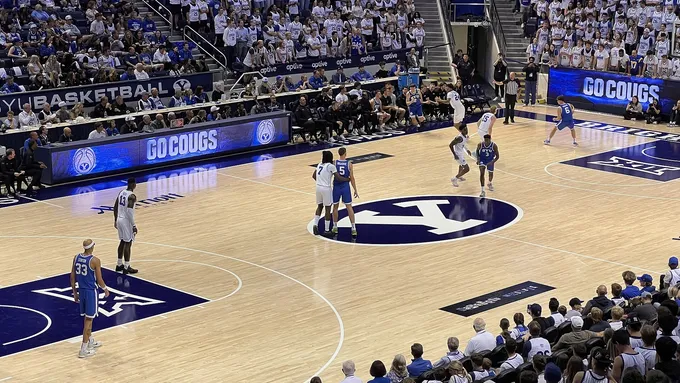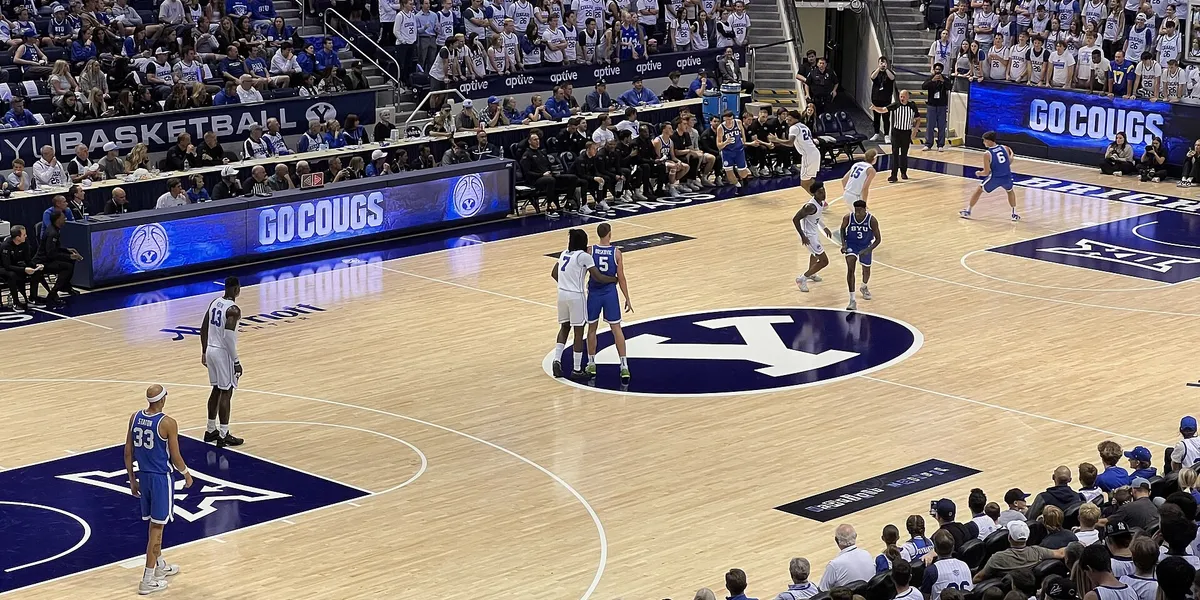
A basketball assistant leaving in July is not usually a five-alarm siren.
It is a clipboard moving, not the Marriott Center roof caving in. Nobody needs to sprint down University Avenue yelling about staff continuity while holding a recruiting graphic like a survival blanket.
But the latest BYU hoops news-radar item — Will Voigt leaving Kevin Young’s staff for Boise State, first surfaced locally by the Idaho Press/Herald Extra cluster and then picked up in BYU basketball chatter — is still worth more than a shrug. Not because one assistant move changes the Cougars’ ceiling by itself. It does not. The bigger issue is what the move tests.
BYU basketball is now built like a program with real national ambition. That means every staff seat has a job description, and every job description matters more than it did when the roster was smaller, quieter and less nationally inspected.
The current BYU men’s basketball roster lists 17 players. It includes six seniors, three true freshmen, two redshirt freshmen, a five-star centerpiece in AJ Dybantsa, a 7-footer in Xavion Staton, Big 12 guard experience with Robert Wright III, proven scoring/leadership from Richie Saunders and a frontcourt that is less a room than a passport control line.
That is a fun problem. It is also a management problem.
Why Voigt’s exit matters without being a crisis
Voigt’s resume has always made him a different kind of assistant. He has head-coaching experience, international experience and player-development credibility — exactly the sort of background that fits Young’s NBA-influenced BYU rebuild.
So, yes, losing that profile has some bite.
But the important question is not whether BYU can find another qualified coach. BYU can. The job is more attractive than it was two years ago, and Young’s staff has already shown it can recruit into a bigger conversation. The important question is whether the Cougars can replace the function Voigt occupied:
| Staff function BYU still needs | Why it matters for this roster |
|---|---|
| Frontcourt development | Staton, Keba Keita, Khadim Mboup, Abdullah Ahmed and Mihailo Bošković give BYU size, but size only becomes winning if roles get clear. |
| International/off-court transition | BYU’s roster includes players from Serbia, Senegal, Mali, France, Austria and Egypt. Fit is not just basketball terminology. |
| NBA-style teaching | Dybantsa will draw the cameras, but the whole roster has to learn spacing, decision-making and defensive accountability quickly. |
| Veteran role management | Six seniors means BYU has adults in the room; it also means minutes, shots and closing-lineup trust have to be handled cleanly. |
That is why this is not a panic-meter column. It is a systems column. Good programs do not treat assistant turnover as a personality quiz. They identify the lost value, replace it and keep the development machine moving.
BYU’s roster is too interesting for vague coaching
The 2025-26 roster is not a simple star-and-sidekicks build.
Dybantsa will own the national spotlight because that is what happens when a projected one-and-done star chooses Provo and turns every opposing fan base into amateur tax attorneys. But BYU’s best version requires more than Dybantsa being brilliant. It requires the staff to create a real hierarchy around him.
Start with the guards. Saunders gives BYU a returning senior voice. Wright arrives with Baylor experience and the kind of point-guard profile that should matter in the Big 12. Dawson Baker, Nate Pickens, Kennard Davis Jr., Jared McGregor and KJ Perry give the staff a crowded perimeter puzzle. That group has enough age to avoid chaos, but enough newness that chemistry cannot be assumed.
Then look at the frontcourt. Keita is a senior Big 12 body. Staton is a freshman 7-footer. Mboup is a redshirt freshman with NBA Academy Africa in his background. Bošković brings European pro-system experience. Ahmed arrives from the Westchester Knicks ecosystem. Dominique Diomande has Washington in his path. Tyler Mrus brings Idaho experience.
That is not a roster you coach with bumper stickers.
It needs specific teaching: who screens and who slips, who plays as a vertical spacer, who can pass from the elbow, who survives switches, who closes games next to Dybantsa, and who is asked to be patient when the minutes are not immediate. The more talent BYU accumulates, the less room it has for fuzzy development plans.
The July timing is survivable — if the replacement is targeted
If this move had happened during the middle of the season, it would be a different conversation. In July, BYU has time. The Cougars can evaluate internal responsibilities, decide whether to hire for recruiting, player development, scouting or international connections, and let Young shape the staff before practices become the daily truth serum.
The mistake would be hiring a generic “good basketball guy” and calling it done.
BYU should be clear about what this roster needs most. If the staff believes frontcourt development is the gap, hire toward that. If the bigger concern is international player adjustment and pro-style preparation, hire toward that. If the priority is scouting/game-planning because Young wants to stay more player-facing, hire toward that.
The beauty of a staff opening is that it can become a self-scout. The danger is treating it like a plug-and-play vacancy.
What fans should watch next
There are three useful checkpoints before this becomes an actual season story.
- Does BYU announce a replacement with an obvious lane? The title matters less than the skill set. Development, frontcourt work, scouting and international recruiting are the lanes to watch.
- Does the roster messaging get sharper? With 17 players and major freshman attention, the staff has to explain roles internally long before fans get a rotation chart.
- Does the staff keep recruiting momentum clean? Assistant departures can create a tiny opening for rivals to whisper. BYU’s response should be boring: clear structure, clear relationships, no drama.
If those boxes get checked, Voigt’s exit becomes a normal byproduct of having desirable people on staff. That is part of winning. When a program gets better, other programs notice the people in the building. Shocking development: Boise State did not hire him because BYU basketball had become invisible.
The bigger BYU takeaway
Kevin Young’s BYU project has moved past the cute-story phase.
The Cougars are not merely trying to prove an NBA assistant can recruit to Provo. They have already changed the room. They are now trying to turn a nationally watched roster into a Big 12 team with spacing, defensive trust, role clarity and enough maturity to avoid becoming a highlight reel with loose bolts.
That is why a staff change matters. Not because it knocks BYU off course by itself. Because it asks whether the program’s infrastructure is as ambitious as the roster.
The answer does not have to be dramatic. In fact, the best answer would be almost boring: identify what Voigt did, hire or redistribute with precision, and let the players feel nothing except clear coaching.
For a BYU fan base that has spent years begging the basketball program to think bigger, this is the next stage of the deal. Bigger programs have bigger rosters, bigger expectations and bigger scrutiny when a staff chair opens.
Welcome to having problems worth solving.
Source links
- Google News discovery: BYU’s Voigt takes job with Boise State
- Google News discovery: Boise State hires BYU’s Will Voigt to be assistant hoops coach
- Google News discovery: Kevin Young loses an assistant on his BYU basketball staff to Boise State
- Official BYU Athletics: men’s basketball roster
- Official BYU Athletics API source used by BYU Sport Nuts: 2025-26 men’s basketball roster data
- BYU Sport Nuts context: men’s basketball hub, men’s basketball roster, AJ Dybantsa player page, Xavion Staton player page, Robert Wright III player page
Want the BYU hoops roster read before the national microscope warms up? Join The Cougar Report.