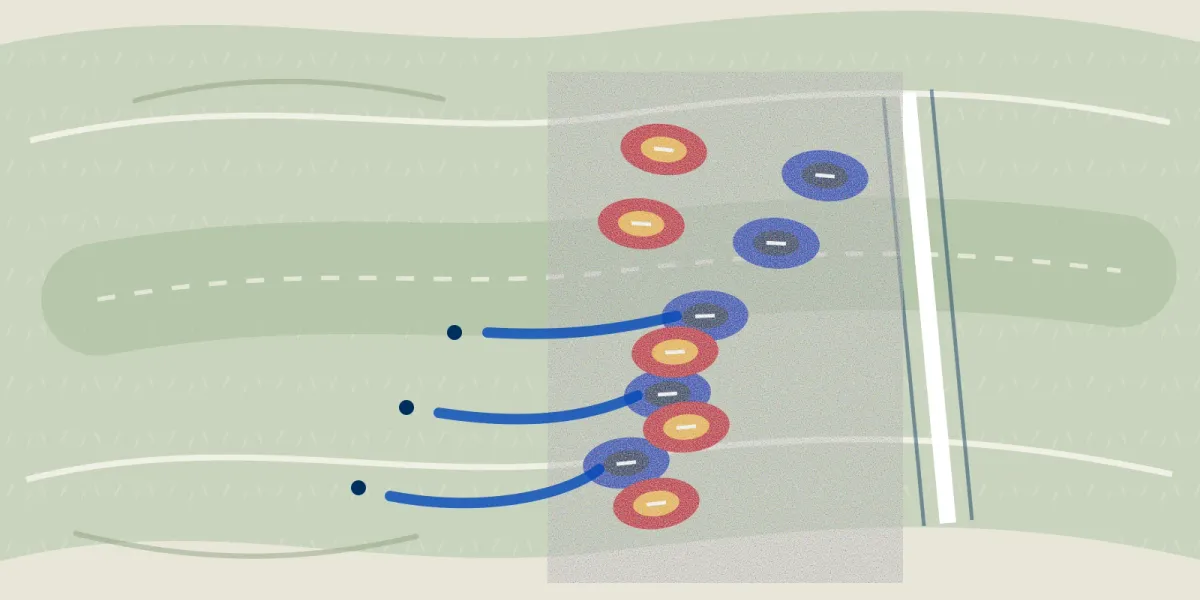
BYU reached the 7K mark one point behind Iowa State. One kilometer later, the Cougars owned third place by 13.
No. 5 BYU scored 91 points Saturday to finish third at the Big 12 men’s cross-country championship in Stillwater, Oklahoma. Colorado won with 36, two points ahead of host Oklahoma State. BYU then won the separate podium fight with Iowa State, 91-104.
James Corrigan led the Cougars in seventh at 23:20.2, breaking Casey Clinger’s BYU record on the Greiner Family OSU Cross Country Course by 9.9 seconds. Tayvon Kitchen followed in 13th. Isaac Hedengren, Dalton Mortensen and Hunter Kitchen closed BYU’s scoring in 21st, 24th and 29th overall.
The top two gave BYU room. The last three used the final stretch to keep it.
BYU’s Big 12 result
| Team place | Team | Scoring places | Points |
|---|---|---|---|
| 1 | No. 3 Colorado | 2-4-9-10-11 | 36 |
| 2 | No. 2 Oklahoma State | 1-3-8-12-14 | 38 |
| 3 | No. 5 BYU | 7-13-20-23-28 | 91 |
| 4 | No. 20 Iowa State | 17-18-21-22-26 | 104 |
| 5 | Arizona | 6-24-42-45-46 | 163 |
The scoring places differ from the overall finish positions because runners beyond a team’s seventh entrant do not add team points. That is why Hedengren’s 21st-place finish counted as 20 points and Hunter Kitchen’s 29th counted as 28.
| BYU runner | Overall place | 8K time | Team points |
|---|---|---|---|
| James Corrigan | 7th | 23:20.2 | 7 |
| Tayvon Kitchen | 13th | 23:34.5 | 13 |
| Isaac Hedengren | 21st | 23:50.6 | 20 |
| Dalton Mortensen | 24th | 23:57.6 | 23 |
| Hunter Kitchen | 29th | 24:04.6 | 28 |
| Scoring total | 91 | ||
| Malachi Schoenherr | 32nd | 24:11.4 | Displacer |
| Jefferson McMullin | 33rd | 24:11.9 | Displacer |
| Noah Jenkins | 36th | 24:17.5 | |
| Land Lambert | 37th | 24:19.4 | |
| Carter Cutting | 61st | 24:54.3 |
PrimeTime Timing marks the meet complete and publishes the full 13-team score, all 103 finishers and two DNFs. The Big 12 and Oklahoma State independently report the same 36-38-91-104 top four.
Corrigan changed BYU’s scoring shape
The How to Watch guide identified BYU’s second-to-fifth spread as the central test. That was still true, but Corrigan changed which runner stood at the front of it.
Tayvon Kitchen had been BYU’s first finisher in every race he entered this season. Corrigan took that job Saturday. His seventh-place card was BYU’s best, and his 23:20.2 was 9.9 seconds faster than Clinger’s previous BYU best on the course, set in 2022.
That did not make Corrigan the race winner. Oklahoma State’s Denis Kipngetich won in 23:05.7, and six runners crossed before Corrigan. It did give BYU something Iowa State could not match: two scoring cards inside the first 13 finishers.
Corrigan and Kitchen totaled 20 points. Iowa State’s first two, Joash Ruto and Mikah Peters, totaled 35. That 15-point advantage at the front became the entire podium margin, plus two points of cushion.
The last three comparisons actually favored Iowa State by two:
| Scoring card | BYU | Iowa State | Direct edge |
|---|---|---|---|
| 1 | 7 | 17 | BYU by 10 |
| 2 | 13 | 18 | BYU by 5 |
| 3 | 20 | 21 | BYU by 1 |
| 4 | 23 | 22 | Iowa State by 1 |
| 5 | 28 | 26 | Iowa State by 2 |
BYU did not beat Iowa State by stacking five runners ahead of five Cyclones. Corrigan and Kitchen built the advantage. Hedengren, Mortensen and Hunter Kitchen prevented the back half from giving it away.
That distinction matters because it is a different formula from BYU’s September win at Terre Haute, where the Cougars put five in the top 20. Saturday’s card was less compact and more dependent on two low scores. It still worked against the team directly behind them.
One point down at 7K was not the final score
BYU’s official recap says the Cougars and Cyclones traded third place at every 1,000-meter checkpoint through the second half. Iowa State led by one point at 7K.
Cross-country scoring is especially rude at that stage. A one-point live margin can flip several times while runners are separated by only a few strides, and the fifth scorer can move the team total more than the athlete at the front. The scoreboard is a snapshot until everybody is through the chute.
BYU’s decisive move came from the middle and back of its card. Hedengren and Mortensen each passed two Iowa State runners over the final 2K, according to BYU Athletics. Hunter Kitchen also supplied one of the closing pushes that put the Cougars back on the podium.
The final sheet shows the result of those moves. Hedengren finished between Iowa State’s second and third runners. Mortensen split the Cyclones’ fourth and fifth. Hunter Kitchen crossed three places after Iowa State’s fifth, but BYU’s front-two advantage could absorb that loss.
BYU finished its five-runner team clock in 1:58:47.5, 24.2 seconds ahead of Iowa State. The average gap was 4.9 seconds per scorer. Team places, not cumulative time, decided the standings, but the clock gives the final kilometer some scale. BYU turned a one-point live deficit into a 13-point final edge without a giant time gap between the two complete scoring groups.
This was not a title charge. Colorado and Oklahoma State were gone. Both put all five scorers in the first 14 overall, while BYU’s fifth arrived 29th. The useful win was narrower: BYU recognized the podium race it could still settle and closed it.
Colorado showed BYU the national-level gap
Colorado’s 36-point title was built with almost no weak spot. Dominic Serem placed second and Meshack Kipruto fourth. Jack Graffeo, Isaiah Givens and Jake Liebert then finished ninth, 10th and 11th.
The Buffaloes’ fifth scorer crossed 9.4 seconds before BYU’s first.
Oklahoma State was nearly as severe. Kipngetich won, Brian Musau placed third, and the Cowboys completed their scoring in 14th. Colorado beat them by only two points, the closest Big 12 men’s team finish since Oklahoma State won a 2020 tiebreaker over Iowa State, according to Oklahoma State Athletics.
BYU was 53 points behind Colorado and 53 ahead of fifth-place Arizona. Third was not a vague middle result. The Cougars were clearly separated from the title pair and clearly separated from the rest after beating Iowa State.
That matches the October evidence. Colorado beat BYU 93-146 at Nuttycombe. Saturday reduced the raw score, but conference field sizes make direct point-total comparisons weak. The stronger comparison is the scoring order. Colorado closed five before BYU closed one at Greiner. At Nuttycombe, Colorado closed five before BYU closed three.
BYU made progress in the race behind the champion. It did not erase the champion’s pack advantage.
Third is an 11-point improvement, with a different front runner
BYU placed fourth at the 2025 Big 12 meet with 102 points. Saturday’s 91 was an 11-point improvement and moved the Cougars onto the conference podium.
The more interesting change is how they got there. Last year BYU’s scoring five finished 15th, 17th, 19th, 22nd and 30th. Nobody supplied a top-10 card. This year Corrigan finished seventh and Kitchen 13th, giving the Cougars 20 points through two runners instead of 32.
Corrigan’s performance is more than a course-record note because it changes BYU’s options. The Cougars entered the meet with Kitchen as the reliable low card and Corrigan as the second runner. They leave with two men who have led the lineup in a major race.
Hedengren and Mortensen also answered the problem the Nuttycombe recap left open. At Wisconsin, BYU’s third through fifth scorers landed 34th, 42nd and 47th. In Stillwater, Hedengren and Mortensen moved late rather than allowing Iowa State’s scoring pack to lock them out.
Hunter Kitchen’s 28-point card remained BYU’s pressure point. Malachi Schoenherr and Jefferson McMullin arrived only 6.8 and 7.3 seconds later, giving BYU two close replacements but no lower fifth score. That depth is useful if a runner has a bad day. At nationals, the better version is getting one of those three through the field earlier so the fifth card stops carrying the largest number.
Schoenherr’s 32nd-place finish was also his conference-championship debut. He was BYU’s sixth runner and the fourth freshman across the line. A six-runner spread of 51.2 seconds is not yet Colorado’s title pack, but it gives the Cougars another postseason option.
Mountain Regionals is the next receipt
BYU races the NCAA Mountain Regional on Friday, Nov. 13 at noon Mountain in Albuquerque. The men’s cross-country schedule carries the permanent event link, and the men’s cross-country hub keeps the roster and postseason route together.
The regional is not a ceremonial stop. It determines the automatic national qualifiers, with at-large selections completing the NCAA field. BYU’s job is to advance without treating third at Big 12s as proof that the fifth-runner problem has disappeared.
Stillwater supplied a better answer than the regular-season finale. Corrigan broke BYU’s course record and took seventh. Kitchen gave the Cougars a second All-Big 12 runner in 13th. Hedengren, Mortensen and Hunter Kitchen moved enough late to turn a one-point deficit into a 13-point podium margin.
Colorado showed the title standard. BYU showed it could finish the race that remained.
Sources and further reading
- BYU Athletics event 25395 and the 2026 men’s cross-country schedule for the stable event ID, completed status, 91-point third place, venue and regional follow-up.
- BYU Athletics: No. 5 BYU rides late push to third for BYU’s runner order, the one-point deficit at 7K, late movement, Corrigan’s course record and the Nov. 13 regional start.
- PrimeTime Timing: completed championship page and final men’s 8K results for all individual places and times, scoring cards, team totals and complete status.
- Big 12 Conference: BYU and Colorado secure conference titles for conference confirmation of Colorado’s 36-point win, BYU’s third place and the top-15 All-Big 12 line.
- Colorado Athletics: men’s cross country wins Big 12s for the champion’s scoring order and race-position context.
- Oklahoma State Athletics: Kipngetich wins individual title for independent confirmation of the top four teams, Kipngetich’s 23:05.7 win and the two-point title margin.
- BYU’s official color guide and Iowa State’s official brand identity resources for the verified palettes used in the original editorial illustration.