BYU finished a new recruiting lounge, renovated the home locker room and opened a hospitality space at LaVell Edwards Stadium before the 2026 football season. The concrete work in the northwest corner is ready too.
The two-story premium club that construction is meant to support is not.
That timeline is the useful part of BYU Athletics’ Saturday announcement. Four projects sit under one stadium-upgrade headline, but they do not all change the experience for the same person. Two are built for recruits and players. One replaces an existing hospitality area for athletics guests and corporate partners. The most visible long-term addition, the PACS Pavilion, is scheduled for construction after this season and completion before the 2027 season.
For fans walking into the Sept. 5 opener against Utah Tech, the stadium will look more finished in the northwest corner. BYU has not announced a broad seating-capacity increase, a new public ticket section or a general gate and parking change as part of this release.
Here is what is actually ready, who each project serves and what still has to wait.
The four projects do four different jobs
BYU’s announcement and Sean Walker’s independent report for KSL Sports agree on the basic project map.
| Project | 2026 status | Primary use | What fans should know |
|---|---|---|---|
| PACS Recruit Lounge | Ready | Football recruits and their families | This is a recruiting tool under the east stands, not a public concourse lounge |
| Home locker room renovation | Ready | BYU players and football staff | It changes the game-day workspace behind the scenes |
| LaVell’s Lounge | Ready | Athletics guests and corporate partners | It replaces Gridiron Grill West with updated hospitality space |
| Northwest platform / future PACS Pavilion | Platform ready; club construction follows the season | Future premium hospitality | The two-story club is expected for 2027, not opening day 2026 |
The distinction matters because “stadium upgrade” can sound like every ticket holder is receiving a new seat, concession stand or entry route. That is not what BYU announced. This round is mostly an investment in recruiting, team operations and premium hosting, plus structural work for the next phase.
That does not make the projects unimportant. It does mean fans should judge them by the problem each one is trying to solve.
Recruiting finally gets a game-day home
The new PACS Recruit Lounge sits under the east stands near the home locker-room area. BYU says it includes seating, food and drink options, and entertainment areas for recruits and their families.
That solves a specific Saturday problem. A campus visit is not only a seat in the stadium. Coaches need a place to gather prospects and families before the game, host them between activities and keep the visit connected to the football operation. A dedicated room gives the recruiting staff more control over that experience than a temporary gathering area does.
The timing also fits the current recruiting calendar. BYU’s 2027 class analysis has tracked how the program is trying to turn Big 12 results into better roster depth. Home games against Arizona, Iowa State, Notre Dame and Baylor give the staff four high-interest weekends after the Utah Tech opener. The lounge will not win a recruitment by itself, but it removes an avoidable facilities disadvantage during those visits.
For the general ticket holder, this is not a new place to stop for food. BYU describes it as a recruit-and-family hub. Fans should not read “lounge under the east stands” as a public amenity unless the school later announces public access.
The home locker room catches up behind the scenes
BYU renovated its everyday football locker room in the Student Athlete Building in 2021. The visiting locker room at LaVell Edwards Stadium was upgraded before the 2024 season. The game-day home locker room was the remaining piece.
The new version has lockers, technology, player amenities and other improvements, according to BYU. KSL reports that the older room had been a recurring complaint among players and coaches who use it before games, at halftime and afterward.
This is the least visible project and probably the easiest one to understand. The Cougars spend most workdays in the Student Athlete Building, but their most time-sensitive Saturday conversations happen inside the stadium. A halftime room needs to support position meetings, medical work and quick adjustments without fighting dated equipment or layout.
No locker-room renovation blocks a blitz. It can make the 20-minute halftime window less clumsy. For a program that has sold continuity as an advantage, updating the room where coaches must make their fastest in-game corrections was overdue housekeeping.
LaVell’s Lounge is a replacement, not a new public section
LaVell’s Lounge occupies the upper-concourse area between the west and north stands, under the west stands. It replaces Gridiron Grill West and adds an expanded concessions menu, seating, televisions, decor and other amenities.
BYU identifies athletics guests and corporate partners as the users. Qualtrics sponsors the space.
That wording puts a boundary around the fan impact. BYU did not announce individual tickets, public reservations, a season-ticket package or a walk-in policy for the lounge. Until it does, the safe reading is that this is an updated hospitality room in an existing hosted area, not a new option every fan can buy on game day.
The space still matters to the stadium business. BYU added a corporate jersey patch across its Olympic sports this summer, a move we examined in our athletics sponsorship analysis. A better room for sponsors and hosted guests is another piece of the same revenue environment. It gives the department a more useful place to maintain those relationships during its biggest home events.
Fans can have two thoughts at once. Better hospitality inventory can help BYU earn money in the Big 12 arms race. It is also fair to notice that Saturday’s announcement does not describe a comparable new amenity for ordinary seats.
The northwest platform is preparation for 2027
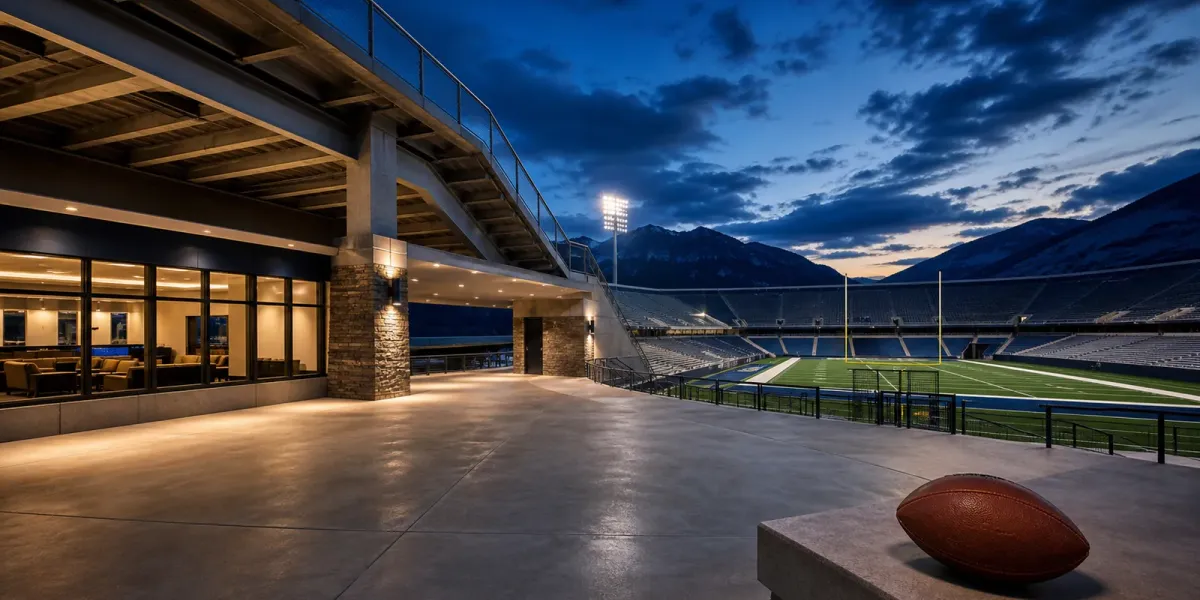
The largest source of confusion is the northwest corner. BYU removed and rebuilt the infrastructure that connects the west and north stands. The new platform has a deeper foundation designed to support a two-story premium club.
The platform is ready for 2026. Construction on the PACS Pavilion begins after the season, and BYU expects the club to be complete in time for 2027.
So fans will see completed structural work this fall, but they should not expect a finished two-story pavilion above it. The project is deliberately split across seasons so the stadium can host the 2026 home schedule before the next construction phase begins.
BYU has not attached a new seat count, capacity figure, ticket price or sales date to the future pavilion in this release. It calls the building a premium club. Anything more specific would be guesswork.
That leaves four questions for the next announcement:
- How many guests will the pavilion hold?
- Will access be sold through season tickets, Cougar Club levels, corporate packages or another model?
- Does it add seats or reorganize existing premium inventory?
- What concourse routes, concessions or restrooms will change around the northwest corner?
Those answers will determine whether the pavilion alters stadium flow for everybody or mainly adds a new hosted destination.
What to expect for Utah Tech
BYU opens at LaVell Edwards Stadium against Utah Tech on Saturday, Sept. 5 at 6 p.m. Mountain on ESPN+. The game details are already on our football schedule, and the football hub will carry the next-game information as opening day approaches.
The practical stadium checklist is shorter than the construction list:
- The recruiting lounge and renovated locker room will be operating out of public view.
- LaVell’s Lounge replaces Gridiron Grill West for BYU’s hosted guests and corporate partners.
- The rebuilt northwest platform will be visible, but the two-story pavilion will not open until 2027 if the announced schedule holds.
- BYU has not announced a general ticket, capacity, parking or gate change in connection with these projects.
The upgrade announcement is real. So is its limited public scope in 2026. BYU improved the rooms that help recruit players, prepare the team and host partners, then laid the foundation for a larger premium project next year.
Fans get a cleaner northwest corner now. The bigger building is still one season away.