The fun part of recruiting season is the screenshot.
A commitment graphic drops, the class ranking updates, every rival fan suddenly becomes an expert in composite math, and somebody in the group chat starts typing like the entire future of the Big 12 has been settled by a teenager’s hat choice. It is summer. This is what we do now.
But BYU’s current recruiting conversation deserves a better question than “how high can the class climb?” That question is on the public news radar this week, with Sports Illustrated tracking the Cougars’ pivotal June momentum, Deseret News asking whether BYU can duplicate last cycle’s recruiting success, and On3 flagging a Thursday decision date for four-star lineman Uhila Wolfgramm with BYU and Oklahoma in the mix.
Those are real signals. They are also incomplete signals.
The better BYU question is this: does the recruiting class solve the next roster problem, or just win the next ranking refresh?
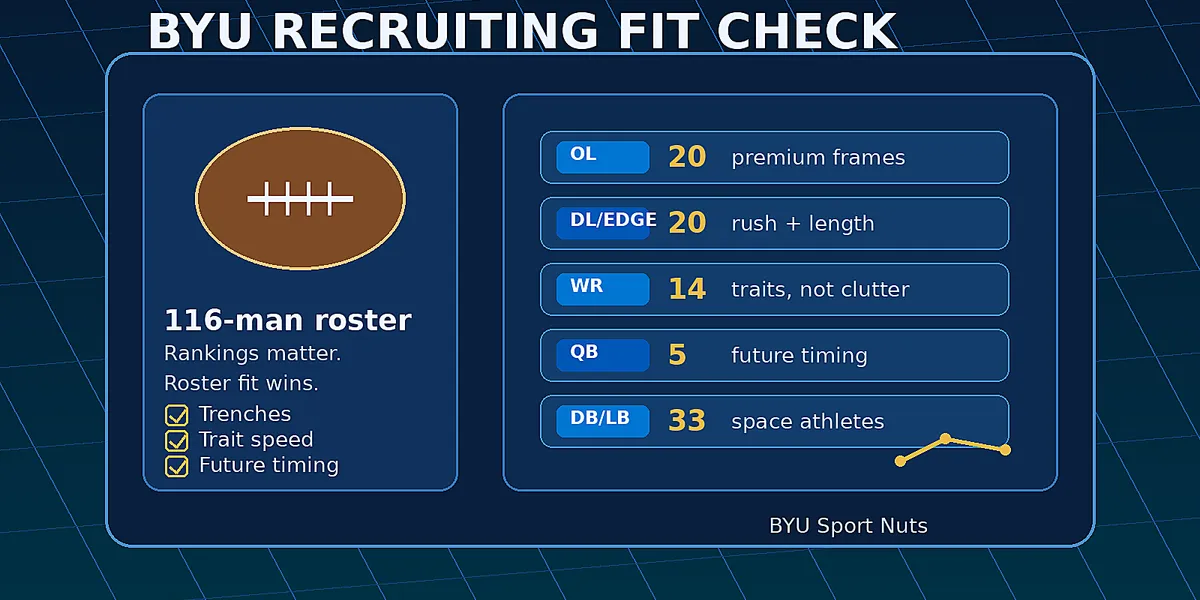
That distinction matters because the current BYU football roster already has size. It lists 116 players, including 20 offensive linemen, 14 wide receivers, 14 linebackers, 11 defensive ends, 10 safeties, 10 tight ends, nine running backs, nine cornerbacks, nine defensive tackles and five quarterbacks. This is not a program trying to discover whether football requires bodies. It has bodies.
The next step is sharper: BYU has to keep stacking Big 12-caliber fits in the places where the roster churns, ages or still needs a higher ceiling.
The roster tells BYU where recruiting has to be surgical
Class rank is useful as a temperature check. It is not a depth chart.
A top-35-ish summer feeling can be encouraging and still fail the real test if the signees do not land in the right rooms. BYU’s roster shape makes that clear:
| Current roster room | 2026 count | Recruiting implication |
|---|---|---|
| Offensive line | 20 | BYU can develop numbers, but must keep adding Big 12 frames because line misses take years to fix. |
| Defensive line / edge | 20 | The Cougars need pass-rush ceiling and interior length, not just rotational inventory. |
| Wide receiver | 14 | The room is crowded; the target should be difference-making traits, not more similar profiles. |
| Quarterback | 5 | The room has depth, but BYU still has to recruit future timing around Bear Bachmeier and younger options. |
| Linebacker / safety | 24 | BYU’s defensive identity depends on athletes who can tackle, cover space and survive Big 12 tempo. |
That is why a recruitment like Wolfgramm’s is more than a star-count story. If BYU is in a real public battle with Oklahoma for a four-star offensive lineman, the win would signal more than one future blocker. It would show the Cougars can recruit the kind of high-value trench body that changes the long-term math.
The Big 12 does not politely wait for offensive linemen to become useful. It asks whether they can handle speed, weight and disguised pressure before the popcorn is warm. BYU can be patient in development, but it cannot be casual in acquisition.
BYU’s June buzz is valuable because it compounds
There is a reason the recruiting headlines feel louder now than they did during plenty of independent-era summers.
BYU is selling a different package: Big 12 membership, national basketball momentum around campus, a football staff with continuity, a fan base that travels, and a program identity that is unusually clear. Not every prospect is looking for the same thing. That is fine. BYU is not trying to be a generic helmet school with better mountains.
What matters is that the staff is getting into more serious conversations.
That is where the public momentum around a pivotal June matters. Even if every single headline does not become a commitment, the bigger signal is that BYU is spending more time at tables where the waiter brings steak knives instead of crayons. The Cougars are not merely collecting local fallback options. They are pushing into nationally relevant recruitments while still leaning into the Utah/West footprint that makes the program different.
The roster geography supports that identity. The current roster includes 61 players from Utah, 16 from California, nine from Arizona, seven from Texas, six from Hawaii and four from Idaho. BYU still has a home-base advantage. The trick is using that base as a launching pad, not a ceiling.
The danger is confusing noise with needs
Here is the part where we gently remove the recruiting air horn from everyone’s hand.
A hot June does not mean BYU has solved roster management. It means BYU has momentum. Momentum is good. Momentum is also the easiest thing in sports to turn into a commemorative T-shirt five months too early.
The staff still has to answer three harder questions:
- Are the offensive and defensive line targets good enough to change the Big 12 trench ceiling? BYU’s roster has numbers up front. Recruiting has to add difference-makers, not just depth-chart upholstery.
- Are the skill commitments distinct? With 14 receivers and nine running backs already listed, new additions should bring obvious trait value: speed, size, return ability, contested-catch skill or defensive flexibility.
- Does the class protect the future after the veteran core? The current roster has 21 seniors or redshirt seniors, but it also has 49 freshmen or redshirt freshmen. BYU is not old everywhere. It needs the right bridge players and the right developmental bets.
That is why the Wolfgramm-type recruitments matter so much. They sit at the intersection of need, ceiling and perception. Beat a brand like Oklahoma for a lineman, and BYU fans are allowed to enjoy the confetti. Lose one, and it is not a funeral. But the pattern matters. The Cougars need to keep being credible in those rooms.
Kalani Sitake’s culture pitch has to become a recruiting filter
KSL Sports’ news-radar clip this week framed Kalani Sitake’s BYU culture as something money cannot buy. That is a useful phrase, but only if it becomes more than a refrigerator magnet.
Culture should help BYU identify who fits before everyone else catches up. It should help the staff sort between players who merely like the idea of BYU and players who can thrive in Provo’s specific environment: faith context, expectations, academics, family networks, national travel and the reality that BYU fans can turn a June official visit into a family reunion with snacks.
The best version of BYU recruiting is not anti-NIL, anti-stars or anti-modern. That would be adorable and doomed, like bringing a hymnbook to a drone fight. The best version is selective aggression. Pay attention to the market. Compete for premium bodies. Use the culture pitch as a filter, not an excuse.
That is how BYU can build classes that look good on signing day and still look good when the players become juniors.
What fans should track next
For the next month, ignore one-day ranking swings unless they come with actual names attached. Watch the roster fit instead.
- Trench wins: offensive tackle, interior line and edge/defensive tackle remain the rooms where one right commitment can change the future more than three luxury skill additions.
- Recruiting geography: BYU should keep owning Utah and the LDS-adjacent West while proving it can selectively win Texas, California, Hawaii and national battles.
- Trait diversity: the class should add speed, length and pass-rush tools. If every commit looks like a player already in the room, the class is less interesting than the ranking suggests.
- Public battles: being a finalist against blue-blood programs is not enough forever, but repeated finalist status is often the step before repeated wins.
- Roster timing: with Bachmeier, LJ Martin and veteran defenders carrying the present, BYU’s 2026 class has to support the next wave without forcing freshmen into emergency work.
The takeaway
BYU’s recruiting momentum is real enough to take seriously and early enough to avoid treating like prophecy.
The Cougars do not need fans to apologize for being excited. June has given them legitimate reasons to refresh the board. But if BYU wants this class to matter in the Big 12, the standard has to move beyond “number went up.” The standard should be whether the class adds premium bodies, solves future roster stress and proves Sitake’s culture pitch can win against programs with bigger brand gravity.
That is the adult version of recruiting optimism.
Celebrate the screenshots. Just read the depth chart after.
Source links
- Google News discovery: How High Can BYU’s Recruiting Class Climb After a Pivotal June?
- Google News discovery: Will BYU ever be able to duplicate last year’s recruiting success?
- Google News discovery: Intel: Four-star Uhila Wolfgramm sets Thursday commitment date, BYU-Oklahoma in a tight one
- Google News discovery: The BYU Culture Kalani Sitake Has Instilled That Money Can’t Buy
- Official BYU Athletics: BYU football roster
- Official BYU Athletics API source used by BYU Sport Nuts: 2026 football roster data
- BYU Sport Nuts context: football hub, football roster, football recruiting tracker, Bear Bachmeier player page, LJ Martin player page
Want the recruiting board without the message-board whiplash? Join The Cougar Report.