The loudest offseason stories usually come with moving trucks.
A coordinator leaves. A quarterback portal thread turns into a neighborhood watch. A rival hires somebody with a headset and everyone pretends they knew his third-down tendencies in 2019. College football has become a sport where stability is so rare that it almost looks suspicious.
That is why the latest news-radar item around BYU football — a USA Today headline framing the Cougars as having “survived the coaching carousel” and now being built to win big — is worth slowing down on. The headline is not the analysis. The useful question is this:
What does stability actually buy BYU in 2026?
The answer is not a trophy in June. Nobody should hang a banner for keeping the building from catching fire. But when the current BYU football roster has 116 players, a returning young quarterback with real production, a senior feature back, a veteran defensive spine and a schedule that gets serious immediately, continuity becomes more than a nice press-conference word.
It becomes an edge if BYU turns it into cleaner execution faster than everyone else.
Continuity is most valuable where football is slow to learn
College football fans tend to measure offseason wins by talent acquisition. That matters. Stars are not decorative sprinkles. They are often the difference between a contested catch and a prayer request.
But continuity has its own currency, especially in the parts of football that punish hesitation: offensive line communication, quarterback protection calls, defensive fits, third-down pressure checks and special-teams operation. The stuff that makes a team look boringly prepared in September is usually installed in February, repped in March and trusted in August.
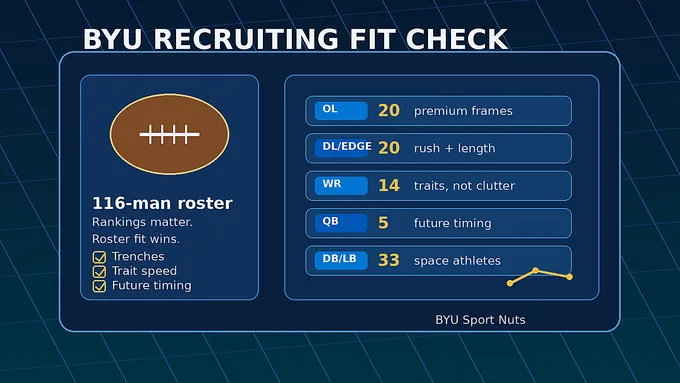
BYU’s roster construction gives that idea some teeth. The current roster includes:
| 2026 roster area | Current count | Why it matters |
|---|---|---|
| Total players | 116 | Enough inventory to create competition without treating every camp rep like an emergency. |
| Offensive linemen | 20 | A deep room for protection continuity and young-player development. |
| Quarterbacks | 5 | A real room behind Bear Bachmeier, not a single-point failure. |
| Running backs | 9 | Enough bodies to protect LJ Martin from becoming the entire run game by himself. |
| Wide receivers | 14 | A big enough group to sort roles around Tiger Bachmeier, Jojo Phillips and the younger targets. |
| Seniors / RS-seniors | 21 | Veteran ballast in a sport that keeps trying to turn every roster into wet cement. |
Those numbers do not guarantee a Big 12 run. They do suggest BYU should not need the first month of the season to learn everybody’s name tag.
That matters because the 2026 schedule does not wait politely. BYU opens with Utah Tech, then immediately gets Arizona in Big 12 play before a road trip to Colorado State and another conference checkpoint against TCU. If a team is still figuring out its base communication by mid-September, the league will happily turn that into a group project titled “Why Are We Punting Again?”
Bear Bachmeier is the continuity test case
The simplest way to make stability matter is to make the quarterback more fluent.
Bachmeier’s public stat profile is already meaningful: 3,033 passing yards, 15 passing touchdowns, 527 rushing yards and 11 rushing touchdowns in the WMT-derived BYU Sport Nuts database. That is not theoretical upside. That is production with enough dual-threat stress to change how defenses allocate bodies.
The next step is not just “more highlights.” It is fewer dead possessions. Fewer second-and-12s created by a missed protection. Fewer drives where the quarterback has to be magician, plumber and crisis counselor before the sticks move.
Continuity helps there because a returning quarterback can spend less time learning the grammar of the offense and more time mastering the accent. Where is the hot answer against pressure? Which receiver wins leverage on a sight adjustment? Which run check gets BYU into a clean box for Martin? Which protection call keeps a young tackle from being isolated against a bad matchup?
Those are not brochure questions. They are Big 12 questions.
The veteran defensive spine is the less glamorous part of the story
If BYU is going to be built to win big, the defense has to be more than the unit that waits for the offense to be interesting.
The returning production is real. Isaiah Glasker is listed with 140 career tackles, 23 tackles for loss, 6.5 sacks and five interceptions. Keanu Tanuvasa brings 33 career starts and interior credibility. Raider Damuni has 90 career tackles from the safety room. Evan Johnson has seven career interceptions at corner.
That is the kind of defensive experience that should let BYU disguise without confusing itself. There is a difference between being multiple and being a garage sale with cleats. Veteran defenders raise the ceiling only if the system lets them play fast.
This is where staff continuity matters most. A stable staff can install adjustments on top of a shared language instead of re-teaching the alphabet. It can ask Glasker to weaponize experience, not merely survive another terminology reboot. It can let the secondary anticipate splits and route combinations because the defensive call sheet has roots.
Again: not a guarantee. Just a legitimate reason for optimism that is better than “the vibes passed inspection.”
LJ Martin turns stability into offensive identity
Martin is the other obvious place where continuity can become a weekly advantage.
The database credits him with 2,541 rushing yards, 23 rushing touchdowns, 57 receptions and 398 receiving yards. He is not a mystery box. BYU knows what it has: a senior back with enough all-purpose utility to punish defenses that overplay one menu item.
The question is whether BYU can keep him efficient. That depends on the offensive line, the quarterback run threat, receiver blocking, tight-end usage and play-caller patience. In other words, it depends on the parts of a program that benefit from not starting over.
A stable offense should be able to answer the weekly question: “How do we make Martin dangerous without making him disposable?” Some weeks that means inside-zone patience. Some weeks it means screens and angle routes. Some weeks it means Bachmeier holding the backside defender just long enough for Martin to turn a crease into a problem.
That is where continuity stops being sentimental. It becomes tactical.
The danger: stability can become comfort
There is a trap here, and BYU fans should name it before Utah fans pretend they invented skepticism.
Continuity is not automatically progress. Keeping the same core together only helps if the core improves. A program can be stable and stale. It can know exactly what it is doing and still not be good enough. It can return experience and also return the habits that got it beat.
So the standard should be higher than “BYU did not lose everyone.” The Cougars have to show that the familiar pieces are sharper. Bachmeier needs cleaner operation. The line needs dependable combinations. The pass rush needs more than effort points. The receivers need separation and downfield punishment. The staff needs to win adjustment battles when the first plan gets punched in the mouth.
The good news is that BYU’s continuity gives it a chance to work on those problems from a stronger starting point. The bad news is that the Big 12 does not award extra credit for having your binders organized.
What to watch before the Arizona and TCU checkpoints
The first month should tell us whether continuity is translating into football.
- Does Bachmeier look faster before the snap? If protections and checks are cleaner, the offense should waste fewer early downs.
- Does BYU find a real receiver rotation? A 14-man room is depth only if roles become clear.
- Does the offensive line settle quickly? Twenty linemen is a resource; five dependable starters and three playable backups are a weapon.
- Does Glasker move like a veteran eraser? The defense needs his experience to show up in the right gap before the crowd notices.
- Does Martin’s workload look designed, not desperate? BYU should be able to feature him without turning every drive into a heroic collision count.
If those answers trend positive, the USA Today-style stability framing will have substance behind it. If not, the headline will age like milk in a Provo parking lot in August.
The takeaway
BYU’s quiet offseason advantage is not that the Cougars avoided all change. Nobody avoids change in modern college football. The advantage is that enough of the important pieces appear to be connected: staff language, quarterback experience, veteran defensive production, a deep offensive line room and a feature back who already knows where the bruises live.
That is how a team can get better without needing to become unrecognizable.
The 2026 Cougars still have to prove it against Arizona, TCU, Notre Dame, Utah, Baylor, Kansas and everyone else with bad intentions on the schedule. But if BYU is going to make a serious Big 12 push, it probably starts here: not with one splashy summer headline, but with the compounding value of a program that can spend less time rebooting and more time refining.
In a sport addicted to chaos, boring can be beautiful.
Source links
- Google News discovery: BYU football survived the coaching carousel. Now it’s built to win big
- Official BYU Athletics: BYU football roster
- Official BYU Athletics: BYU football schedule
- Official BYU Athletics: BYU football coaches/staff directory
- WMT/BYU stat source used by BYU Sport Nuts: BYU football stats widget
- BYU Sport Nuts context: football hub, football roster, football schedule, Bear Bachmeier player page, LJ Martin player page
Want the roster math before the noise machine starts stretching? Join The Cougar Report.