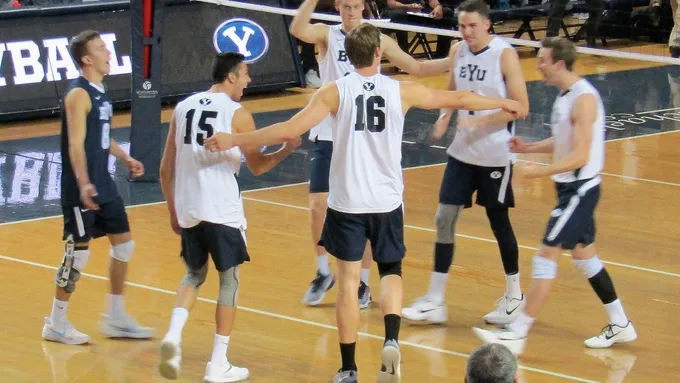
BYU men’s volleyball has been hiding in plain sight on this site.
The team hub, roster and schedule already exist. The official data behind them is sturdy enough to answer useful questions. Yet the program had no article of its own while football recruiting rumors received full weather-system treatment.
That is backwards. Men’s volleyball has an 18-player roster with eight freshmen, four seniors and enough positional overlap to make the next lineup conversation interesting. Its 2026 schedule file also contains a trap that a quick box-count misses.
Here is the file Cougar fans should keep.
Eight freshmen change the math
The class split is the cleanest way into this roster.
BYU lists eight freshmen, three sophomores, three juniors and four seniors. Eleven of the 18 players are underclassmen. That does not tell us who earned the most court time, and it certainly does not settle the next starting lineup. It does tell us this was never a roster built only for one spring.
The senior group gave BYU experience in useful places. Jackson Fife is listed at libero. Tyler Herget is a setter. Trent Moser is a 6-foot-7 outside hitter, while Cole Hauser carries an outside hitter/libero label.
The freshman class spreads across the net rather than piling into one job. Corbin Batista, Tennison Lighthall and Trey Thornton have outside/opposite combinations in their roster labels. Tyler James Johnson is a setter. AJ Cottle and Max Philippe are middle blockers. Evan Olmstead is a libero. That is not a cleanup crew sitting at the end of the bench on paper. It is a possible framework.
There is a catch, of course. An official position label is not a rotation. BYU fans should resist turning the roster page into a depth chart the coaches never published. The better offseason question is which young players can shrink the gap between “interesting measurables” and six reliable rotations.
This is a tall roster with several ways to arrange it
Eleven players are listed at 6-foot-5 or taller. Gavin Chambers is the tallest at 6-foot-9, followed by Cottle at 6-foot-8. Batista and Moser are both 6-foot-7. Height alone does not pass a serve, close a block or rescue a bad first touch, but BYU is not short on front-row options.
The positional labels are even more useful than the height count. The roster has three setters: Herget, Johnson and Kyle Zediker. It has three players listed strictly at middle blocker: Chambers, Cottle and Philippe. Six more players carry slash labels that cross outside hitter, opposite hitter or libero responsibilities.
That flexibility can be real or cosmetic. Sometimes a slash label means a player genuinely gives a staff two answers. Sometimes it is simply the broadest description that fit when the roster was entered. We will need match and lineup receipts before claiming more.
Still, the shape is worth remembering. BYU can build around size. It can also make choices at setter and along the pins without pretending every role has one obvious owner.
The recruiting map is wider than Utah County
Five players list Utah hometowns, the largest state group on the roster. California is next with four. Arizona and Connecticut have two each. BYU also lists one player apiece from Nevada, Florida, Texas and Illinois, plus Bernardo Adam from Itajaí, Brazil.
The local layer matters because men’s volleyball is still a smaller recruiting world than football or basketball. Corbin Batista is from St. George, Cottle from Provo, Lighthall from Pleasant View, Olmstead from Highland and Thornton from Spanish Fork. The roster does not need a geography lesson to feel connected to the building.
It is not provincial, either. Teilon-Jonathan Tufuga is from Long Beach. Moser and Connor Oldani list Arizona hometowns. The Herget brothers come from Darien, Connecticut. Adam gives the roster an international line.
That mix is a healthier story than vague talk about a “national brand.” The receipts are right there: nine states and Brazil on one 18-player roster.
Do not call this a 38-match BYU schedule
The committed schedule file has 38 rows. A fast read would turn that into “BYU played 38 matches.” That is not what the data says.
The first 31 rows are BYU-specific regular-season events from the two Saint Francis dates in January through the two UCLA dates in April. Sixteen are marked home and 15 away. Fourteen carry the conference flag.
Then the official feed adds seven MPSF tournament event rows at Smith Fieldhouse. Five are neutral bracket events between listed opponents. Two are completed, BYU-labeled rows against Stanford and UCLA. Those tournament rows are useful for preserving the event bracket, but they should not all be counted as BYU matches.
This is a small data detail with a big editorial consequence. Schedule pages are only useful when somebody reads the source structure instead of repeating the largest number on the screen.
The 31-row regular-season map still says plenty. BYU had 16 home dates before the tournament layer, including two each against Saint Francis, UC San Diego, UC Irvine, Menlo, Fort Valley, Concordia Irvine, Pepperdine and USC. The road side reached California, Massachusetts and Hawai’i before the closing UCLA set.
The conference stretch was concentrated and repetitive by design: road dates with UC Merced, Jessup, Stanford, Vanguard and UCLA, plus home pairs against Concordia Irvine, Pepperdine and USC. In men’s volleyball, two-match sets are not schedule padding. They are immediate correction tests. Whatever failed the first night gets another examination before the bus leaves.
What to carry into the next roster update
The four-senior spine is the first thing to track, especially at setter and libero. After that, the roster update should tell us how much of the eight-player freshman class remains together and whether any of those broad position labels get narrower.
I am also curious about the three-setter room. It is crowded enough to create options and uncertainty at the same time. The same goes for the pin hitters, where a long list of slash labels looks useful but does not tell us who will actually own a rotation.
BYU’s official roster source is a 2026 snapshot, not a promise about 2027 eligibility, departures or roles. We will update the local pages when BYU publishes a newer roster. Until then, this file gives fans something better than guesses: 18 names, verified measurables, a clear class split and a schedule feed read carefully enough to avoid the 38-match mistake.
Start with the men’s volleyball hub. The all-sports page keeps the broader BYU roster map in one place, and the schedule tracker preserves each official event row for source checking.