The weirdest Big 12 stat of the weekend is not a quarterback number or a win-total projection. It is this: Kalani Sitake is suddenly the league’s longest-tenured head football coach.
Deseret News had the clean news hook Sunday after Mike Gundy’s exit at Oklahoma State changed the math. BYU’s official bio supplies the receipt. Sitake is entering his 11th season as BYU’s head coach in 2026, with an 84-45 record across his first 10 years in Provo and a 57-20 run since 2020.
That is not just trivia. In this version of college football, where rosters churn, staff rooms change, and conference maps look like somebody lost a bet with a geography teacher, BYU has something most Big 12 programs do not: a coach, a culture and a fan base that know each other well enough to skip the introductory awkwardness.
Now comes the less cuddly part. Stability only matters if it turns into cleaner football.
The tenure edge is a floor, not a trophy
There is a lazy way to talk about coaching continuity. It goes like this: same coach, same values, same program, therefore advantage.
Sometimes, sure. But the Big 12 will not give BYU a free third-and-4 because Sitake has been around longer than everybody else. Tenure is useful because it should make the boring parts faster: staff alignment, player evaluation, portal triage, leadership development, practice standards, travel routines, fourth-quarter calm.
BYU should be past the phase where every hard week becomes a referendum on what the program wants to be. Sitake has coached through independence, the COVID oddities, Big 12 entry, a rough first league season, and then the 2024-25 surge. That institutional memory has value.
But it has to show up in ways fans can see. Fewer busted protections. Fewer wasted timeouts. Fewer weeks where the offense looks like it learned the opponent’s defensive front in the parking lot. More road possessions where BYU looks settled while the stadium is trying to turn the game into a wrestling match.
That is the actual tenure test.
BYU’s roster says continuity is possible
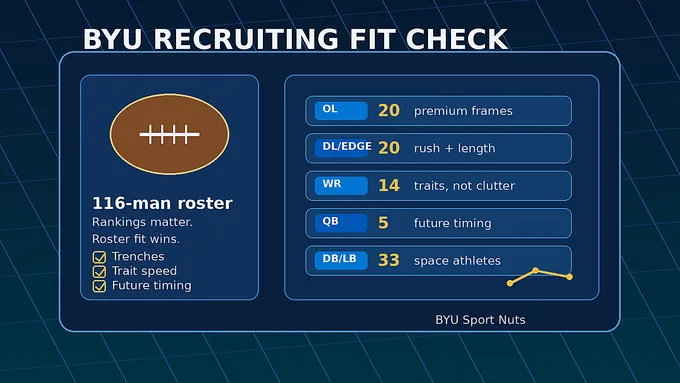
The current official-roster-backed football database has 116 BYU players. The class spread is not some one-year rental situation: 25 freshmen, 24 redshirt freshmen, 19 redshirt sophomores, 21 total juniors or redshirt juniors, and 21 total seniors or redshirt seniors.
That shape gives BYU two jobs at once. The veteran core has to cash in now. The younger half of the roster has to become the next wave before the portal starts asking uncomfortable questions.
The position counts tell the same story. BYU has 20 offensive linemen, 14 wide receivers, 14 linebackers, 11 defensive ends, 10 safeties and 10 tight ends in the local roster file. That is enough bodies to build depth. It is not proof that the depth is game-ready.
This is where Sitake’s continuity should matter. BYU does not need a new annual identity reveal. It needs a staff that can sort the roster quickly, decide which young players are actually playable, and resist the temptation to let September become a month-long experiment.
The Cougars open with Utah Tech, then Arizona six days later. That Arizona game is where the tenure talk stops being cute. A long-tenured program should look like it knows what it is on the first Big 12 Saturday.
The schedule will not care about the scrapbook
BYU’s 2026 schedule has 12 games, nine Big 12 games, seven dates at LaVell Edwards Stadium and five true road games. It also has a middle stretch that will test whether continuity is a real edge or just a nice media-days sentence.
At TCU on Oct. 3. Iowa State at home on Oct. 10. Notre Dame in Provo on Oct. 17.
That is the kind of run where a staff’s habits get exposed. Can the Cougars change plans without changing personalities? Can they win one game with Bear Bachmeier’s legs, another with LJ Martin turning four-yard runs into oxygen, and another because the defense steals two possessions? Can special teams stay quiet in the best way?
Sitake’s best recent teams have had an emotional steadiness about them. The danger is that steadiness can get mistaken for inevitability. Nothing about this schedule is inevitable. The tenure advantage has to become weekly problem-solving.
The 2025 receipt raised the standard
BYU’s official Sitake bio says the Cougars went 12-2 in 2025, finished No. 11 in the final AP poll, and gave Sitake the Big 12 Chuck Neinas Coach of the Year line on the resume. It also says BYU’s 23-4 mark over the last two seasons was one of the best two-year stretches in the country.
That is great. It also makes 2026 more annoying.
The program is no longer selling belief to itself. Fans have seen BYU win in this league. Recruits have seen it. Opponents have seen it. The question is not whether Sitake can build a Big 12 team that matters. He already has.
The question is whether BYU can live in that tier without treating every close game like house money.
This is where the longest-tenured label becomes useful. Not because it flatters BYU, but because it removes a few excuses. If a first-year Big 12 coach has messy substitution patterns, fine, maybe he is still learning his roster. If BYU has them in year 11 under Sitake, fans are allowed to be grumpy before dessert.
What should fans watch?
The answer is not vibes. It is evidence.
Start with the offensive line. Twenty linemen on the roster should give BYU options, but the first five and the next three need to become obvious fast. Bachmeier can erase some mistakes. He cannot be the weekly escape hatch.
Watch the young defensive depth, especially at linebacker, defensive end and safety. Those rooms have enough names to rotate, but Big 12 depth is not a spreadsheet. It is whether the eighth guy in the room can survive a second-quarter series at TCU without the whole sideline holding its breath.
Watch penalties and timeout usage in September. That sounds painfully unglamorous because it is. It is also where long-tenured teams should bank small edges. BYU does not need to win July. It needs to stop giving away cheap snaps in October.
And watch how the Cougars handle a bad quarter. Every good team has one. The long-tenured teams are supposed to keep one bad quarter from turning into three days of public therapy.
The bottom line
Sitake being the Big 12’s longest-tenured coach is a real BYU talking point. It says something about fit, patience and the program’s refusal to become frantic just because the sport around it is frantic.
But it is not a banner. It is a standard.
If BYU uses that continuity to be sharper early, steadier on the road and more honest about its own depth, the tenure edge can be worth a win. Maybe two. If it turns into a pleasant fact everybody mentions before the same old mistakes show up, the Big 12 will shrug and move on.
That is the fun and slightly terrifying part of this season. BYU has the rare thing. Now it has to make the rare thing useful.
Sources and further reading
- Google News discovery: Just like that, BYU’s Sitake is the Big 12’s longest-tenured coach — Deseret News
- Official BYU Athletics: Kalani Sitake staff bio
- Official BYU Athletics: 2026 football roster
- Official BYU Athletics API source used by BYU Sport Nuts: 2026 football roster data
- Official BYU Athletics API source used by BYU Sport Nuts: 2026 football schedule data
- BYU Sport Nuts context: football hub, football roster, football schedule, Big 12 title pressure map, FPI schedule human filter, Bear Bachmeier player page, LJ Martin player page
Want BYU football context without the message-board fog machine? Join The Cougar Report.