The useful thing about nostalgia is that it can still tell the truth if you do not let it wear shoulder pads and talk over everybody.
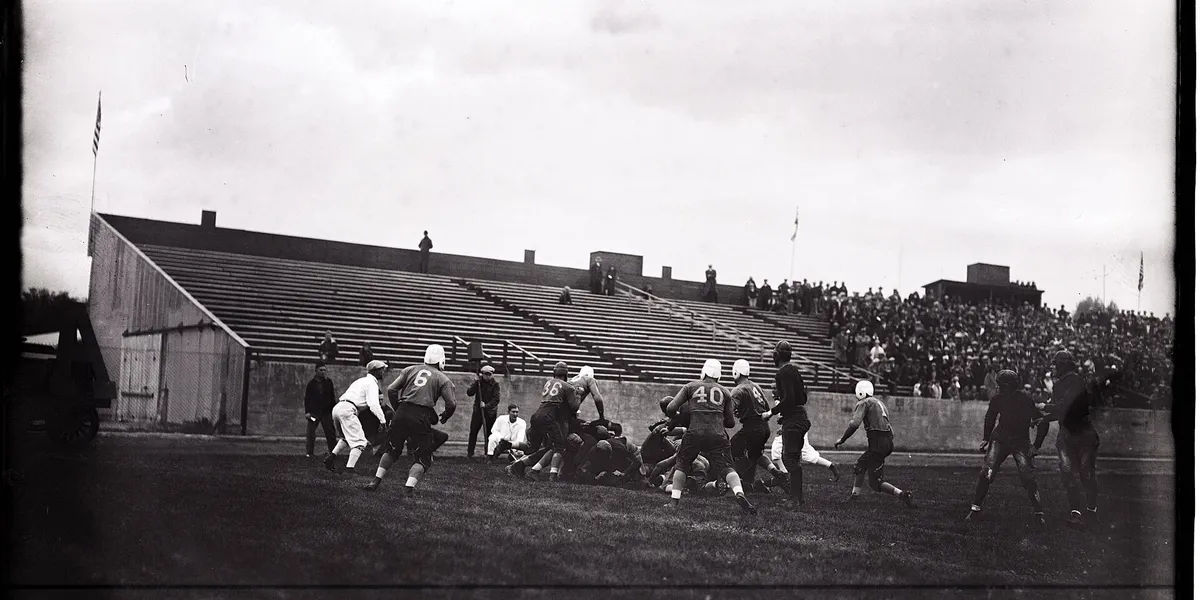
That is why the latest USA Today/Google News look-back at BYU football’s 1996 WAC Championship Game is worth more than a summer scroll. The 1996 Cougars are not just a sepia-toned flex for the alumni group text. They are the cleanest modern-ish example of the standard BYU is trying to make normal again in the Big 12: win the league race, survive the ugly leverage game, and close the year with a result that travels nationally.
The official BYU record is still loud. BYU’s 1996 schedule page lists a 14-1 overall record, 8-0 WAC mark, a 28-25 overtime win over No. 20 Wyoming in the WAC Championship at Sam Boyd Stadium, and a 19-15 Cotton Bowl win over No. 14 Kansas State. BYU’s own 2024 throwback-uniform release adds the larger frame: that team finished No. 5 nationally, the program’s highest finish since the 1984 national-title season.
That is not a museum label. It is a measuring stick.
What 1996 actually says
The easy version of 1996 is, “BYU was great.” True, but not specific enough to be useful.
The better version is this: BYU stacked a season in layers.
First came credibility. The Cougars opened with a ranked Texas A&M team and won. They did not spend September asking the country to trust the brand; they gave the country a receipt.
Then came conference control. The official schedule has BYU at 8-0 in WAC play, which is the detail that matters most when translating the year to 2026. Great seasons are not built only by winning the game everyone circles in Sharpie. They are built by handling the weeks fans try to classify as “take care of business” while the opponent is busy not caring about your label.
Then came championship discomfort. BYU did not boat-race Wyoming in Las Vegas. The Cougars won 28-25 in overtime. That score is the whole lesson. Championship teams are allowed to sweat. They are not allowed to fold because the game refuses to match the pregame speech.
Finally came national validation. The Cotton Bowl win over Kansas State gave the season an ending that could not be shrugged off as a regional hot streak. For a program that has spent decades fighting the “yeah, but who did they beat?” reflex, that part still matters.
The 2025 reminder makes the standard current
This is where the comparison gets interesting rather than dusty.
BYU Sport Nuts’ current Big 12 standings page tracks a 2025 BYU season that finished 12-2 overall and 8-1 in conference play, second in the Big 12 order behind Texas Tech. The local results file shows the shape clearly: BYU started 8-0, beat Utah, Iowa State, TCU, Cincinnati and UCF, reached the Big 12 title game, lost twice to Texas Tech, then beat Georgia Tech in the bowl.
That is an excellent season. It is also exactly why 1996 remains useful.
The modern Cougars have already shown they can live in the top tier of a power conference. The next step is not respectability. BYU is past that. The next step is converting top-tier status into the one result 1996 owns and 2025 chased: conference champion.
That does not mean every good BYU team has to go 14-1. The Big 12 is too deep, travel is too weird, and the weekly trench tax is real. But the 1996 template still applies because the formula is less about record perfection than about season architecture:
| 1996 layer | Big 12 translation |
|---|---|
| Beat a ranked opener | Win at least one national-proof game before voters can hide behind schedule skepticism. |
| Go unbeaten in league play | Protect the games that create tiebreaker leverage, especially at home. |
| Win the close championship game | Be built for ugly fourth quarters, not just pretty September drives. |
| Finish with a bowl statement | Make the last national impression match the season’s ambition. |
The Big 12 version is harder. That is the point. BYU did not join the league to frame participation certificates next to the 1984 trophy.
Why this matters for the 2026 schedule
Look at the 2026 BYU football schedule through the 1996 lens and the checkpoints jump off the page.
Arizona in September is not just a conference opener. It is an early proof game. TCU on the road is not just a trip to Fort Worth. It is a conference-control test. Notre Dame in Provo is the kind of national-brain game that can change how every later BYU result gets interpreted. Utah, Baylor, Kansas and Cincinnati in November form the late-season compression chamber where contenders either keep their structure or start handing out free yards like ward-camp leftovers.
The 1996 team had its own pressure stack. The reason we still talk about it is not because the Cougars avoided pressure. It is because they kept answering it.
For 2026, that means BYU’s season should be judged by more than whether the Cougars are interesting. Interesting is nice. Interesting gets you a television window and a few neutral fans saying, “Hey, BYU is fun.” The 1996 standard asks for more: does BYU own enough Saturdays in a row to make the league race bend around Provo?
The roster piece: boring has to become a weapon
The 1996 nostalgia also points to a less glamorous 2026 truth. Championship contention is not sustained by one recruiting headline, one quarterback argument, or one viral uniform drop. It is sustained by repeatable boring things.
The current BYU football roster has the ingredients for that kind of season if the development hits. LJ Martin gives BYU a proven run-game spine. Bear Bachmeier gives the offense a quarterback profile that can stress defenses on schedule and off script. Bruce Mitchell is the kind of experienced offensive-line reference point that matters when November stops being theoretical.
Defensively, BYU has veterans with real stat receipts: Isaiah Glasker with production in tackles, tackles for loss, sacks and interceptions; Evan Johnson with back-end ball production; Raider Damuni as a tackling presence; Keanu Tanuvasa up front.
None of that guarantees a title run. It does give BYU enough known pieces that the standard can be serious rather than fan-fiction with a navy filter.
The big question is whether the roster turns experience into week-to-week reliability. Can BYU avoid the one flat quarter that changes a conference race? Can the offense finish drives without begging the defense to be perfect? Can the defense turn speed and spacing games into ordinary tackles? Can special teams avoid the comedy category entirely? Please, for everyone’s blood pressure, yes.
The trap in remembering 1996
There is one way to use 1996 badly: treat it like proof that BYU is owed another season like it.
The Cougars are owed nothing. Not by the Big 12, not by television, not by poll voters, and certainly not by Utah fans, who would rather chew tin foil than donate a compliment. The 1996 team is valuable because it did the work before asking history to remember it.
That is the correct lesson for the Big 12 era. BYU’s tradition is not an argument ender. It is an expectation starter.
If the Cougars want to make 2026 feel like more than a follow-up to a strong 2025, they have to do what 1996 did in its own context: own the league details, win the game that gets tight, and make the postseason answer louder than the doubts.
The takeaway
The 1996 WAC Championship Game is not just a greatest-moments clip. It is a reminder that BYU’s best seasons have always combined faith in the program with ruthless attention to the weekly grind.
That is the standard now. Not because 1996 can be copied play-for-play into the Big 12, but because the season’s structure still translates: earn early credibility, stack conference wins, survive the championship moment, and finish nationally relevant.
BYU is not trying to become a cute Big 12 story anymore. The 2025 season already moved the conversation. The 1996 team tells us where the next sentence should point.
Win the league. Make it travel. Let everyone else call it nostalgia after the trophy is already in the case.
Source links
- USA Today via Google News discovery: BYU football’s greatest moments — 1996 WAC Championship Game
- Official BYU Athletics: 1996 football schedule/results
- Official BYU Athletics: 1996 throwback-uniform release with Cotton Bowl/No. 5 context
- BYU Sport Nuts context: 2026 football schedule, Big 12 standings, football roster
Want the old-standard/new-Big-12 lens without refreshing every feed? Join The Cougar Report.