Summer football previews are dangerous because they can make October feel close enough to touch. It is not. There are still roster tweaks, camp reps, a month of non-conference noise, and at least one fan base somewhere convincing itself that a backup tight end’s squat video changed the playoff race.
Still, some schedule spots tell the truth early.
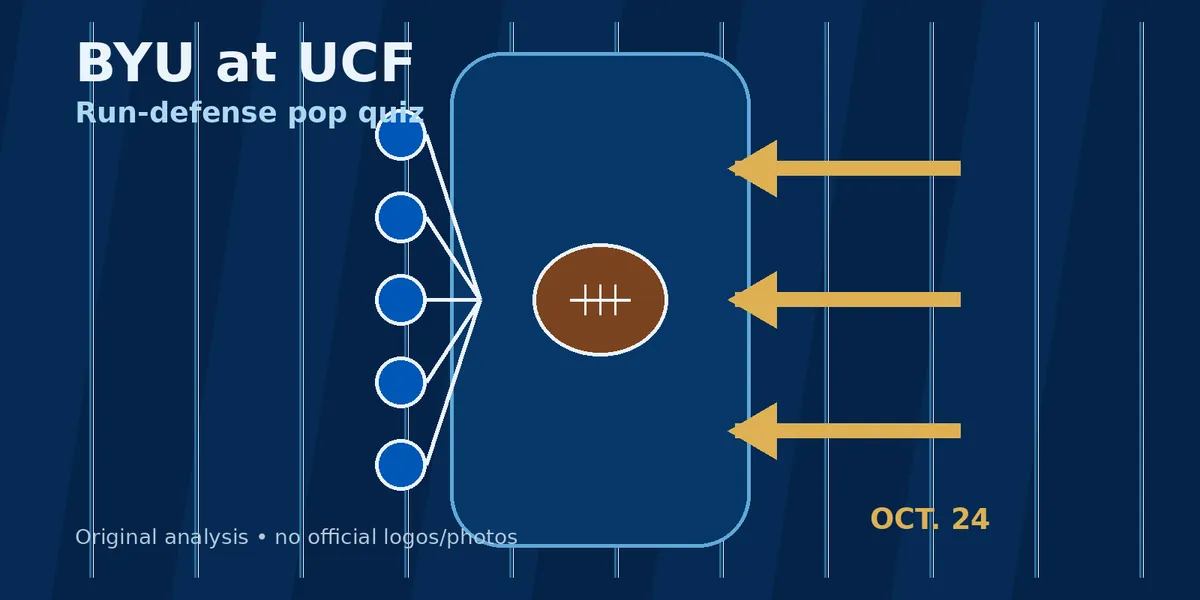
Google News surfaced a USA Today matchup preview framing BYU’s defense against UCF’s ground game as the angle to watch. That is exactly the kind of matchup BYU fans should file away now, because the Cougars’ Oct. 24 trip to UCF at Acrisure Bounce House is not just another Big 12 road date on the football schedule. It is a clean run-defense pop quiz for the roster BYU is trying to sell as sturdy enough for another league chase.
The short version: if BYU is going to be more than a July podium story, the Cougars have to win games where the other sideline wants to make the grass feel uphill. UCF is one of those games.
Why this matchup deserves early attention
BYU’s 2026 schedule has louder brand names. Notre Dame will carry national-search electricity because, well, it is Notre Dame and everybody gets slightly dramatic around gold helmets. The rivalry trip to Utah will come with the usual polite family-text tension, by which I mean absolutely none of it will be polite.
UCF is different. It is a conference road game that asks a narrow football question: can BYU defend the run with enough discipline to keep the whole defensive structure from tilting?
That matters because a dangerous ground game does not merely collect yards. It taxes linebackers, creates second-and-manageable, slows pass rush, tests tackling angles, and turns the fourth quarter into a humidity-and-body-blows seminar. A defense can survive one missed fit. It usually cannot survive a full afternoon of missed fits, late safeties, and edge players learning geometry in public.
BYU does not need to pretend UCF is the only run-game challenge on the schedule. It does need to treat the Orlando trip as one of the cleanest measuring sticks for whether the defensive roster has enough grown-up answers.
BYU’s defensive answer starts with the spine
The good news for BYU is that the roster has a visible defensive spine. Our current facts-only football roster lists nine defensive tackles, 11 defensive ends, 14 linebackers, 10 safeties, and nine cornerbacks. Numbers do not make a run defense by themselves, but they do show BYU is not trying to solve the Big 12 with two veterans, a prayer, and a laminated depth chart held together by sideline tape.
The names at the center of the UCF question are familiar:
| BYU defender | Position | Class | Why UCF matters |
|---|---|---|---|
| Keanu Tanuvasa | Defensive Tackle | RS-Senior | Interior transfer size and experience matter most when the first job is not getting moved. |
| Isaiah Glasker | Linebacker | RS-Senior | BYU’s second-level fit-and-finish player has to turn run-game stress into controlled tackles. |
| Evan Johnson | Cornerback | RS-Senior | Corners still matter in run defense when perimeter force and tackling become weekly Big 12 chores. |
| Raider Damuni | Safety | Senior | Safety angles can be the difference between a five-yard nuisance and a highlight sprint. |
| Bodie Schoonover | Defensive End | RS-Senior | Edges have to squeeze run lanes without handing easy escape routes to the offense. |
The career-stat layer gives the concern some shape. Glasker enters with 140 career tackles, 23 tackles for loss, 6.5 sacks, and five interceptions in the local BYU Sport Nuts player database. Tanuvasa brings 38 games played, 33 starts, 75 tackles, 16.5 tackles for loss, and six sacks. Johnson’s profile includes 65 tackles, seven interceptions, and 10 pass breakups.
Those numbers do not guarantee a stop on third-and-3 in Orlando. They do mean BYU has enough veteran defensive production to make the UCF game a fair test rather than a mystery novel.
The hidden test: tackling without panic
Run defense is often discussed like it belongs only to the defensive line. That is tidy and wrong.
The line has to avoid getting washed. Linebackers have to fit. Safeties have to arrive under control. Corners have to set edges when the ball gets stretched. The whole unit has to avoid the great enemy of all competent defense: eleven people independently deciding to be heroes at once.
That is why this matchup is a useful early-season bookmark. UCF can stress the exact parts of BYU’s defense that determine whether a team is merely talented or actually reliable. If BYU is aligned, gap-sound, and willing to make ordinary tackles look ordinary, the Cougars can keep the game on schedule. If BYU gets impatient, the Knights can make the Cougars chase.
There is a big difference between those two afternoons. One ends with the defense getting off the field. The other ends with fans muttering at the TV like the remote personally missed the B gap.
What the offense has to do for the defense
This cannot be only a defensive preview because run-game opponents are also clock opponents. BYU’s offense has a responsibility here.
If the Cougars are constantly giving the ball back quickly, even a good defense can start looking like it is wearing ankle weights. That puts pressure on the offensive identity BYU has already hinted at with its Big 12 Media Days group: Bear Bachmeier at quarterback, LJ Martin as the run-game tone-setter, and Bruce Mitchell in the middle of the line.
Martin’s career profile in our database includes 482 rushing attempts and 23 rushing touchdowns. That is not just trivia for a player page. In a game like UCF, BYU’s own run game can protect the defense by creating longer drives, fewer desperate possessions, and fewer situations where the Knights get to play downhill with the crowd fully caffeinated.
The best BYU version in Orlando is complementary: tackle cleanly, run enough to breathe, and make UCF drive the long way rather than donating field position like it is a church service signup sheet.
The fan checklist for Oct. 24
When this game week arrives, ignore the fluff and watch these five things:
- First-down run success. If UCF is living in second-and-4, BYU will spend the night doing math it does not enjoy.
- Glasker’s tackle depth. Stops after two or three yards are wins. Stops after seven are receipts.
- Tanuvasa’s anchor. Interior movement is the run-game weather report.
- Safety angles. Damuni and the back end cannot turn routine fits into emergency chases.
- BYU’s offensive patience. Martin and the line do not need to be glamorous. They need to be useful.
The takeaway
UCF is not the biggest logo on BYU’s schedule, but it may be one of the best early definitions of BYU’s defensive floor.
A team that wants to stay in the Big 12 race has to survive games like this: road environment, physical stress, and an opponent trying to make every defensive mistake feel expensive. BYU has the veteran spine to answer. The October question is whether that spine bends, holds, or starts looking for a chiropractor by the third quarter.
Circle the UCF game now. Not because it is the whole season, but because it is the kind of game that tells you whether the season’s biggest ambitions have enough shoulder pads underneath them.
Source links
- USA Today via Google News discovery: BYU football matchup preview — Cougars’ defense vs UCF ground game
- Official BYU Athletics schedule source used by BYU Sport Nuts: BYU football schedule data via byucougars.com
- BYU Sport Nuts context: football schedule, how to watch BYU at UCF, football roster, BYU Big 12 Media Days identity analysis
Want the schedule signal before October turns spicy? Join The Cougar Report.